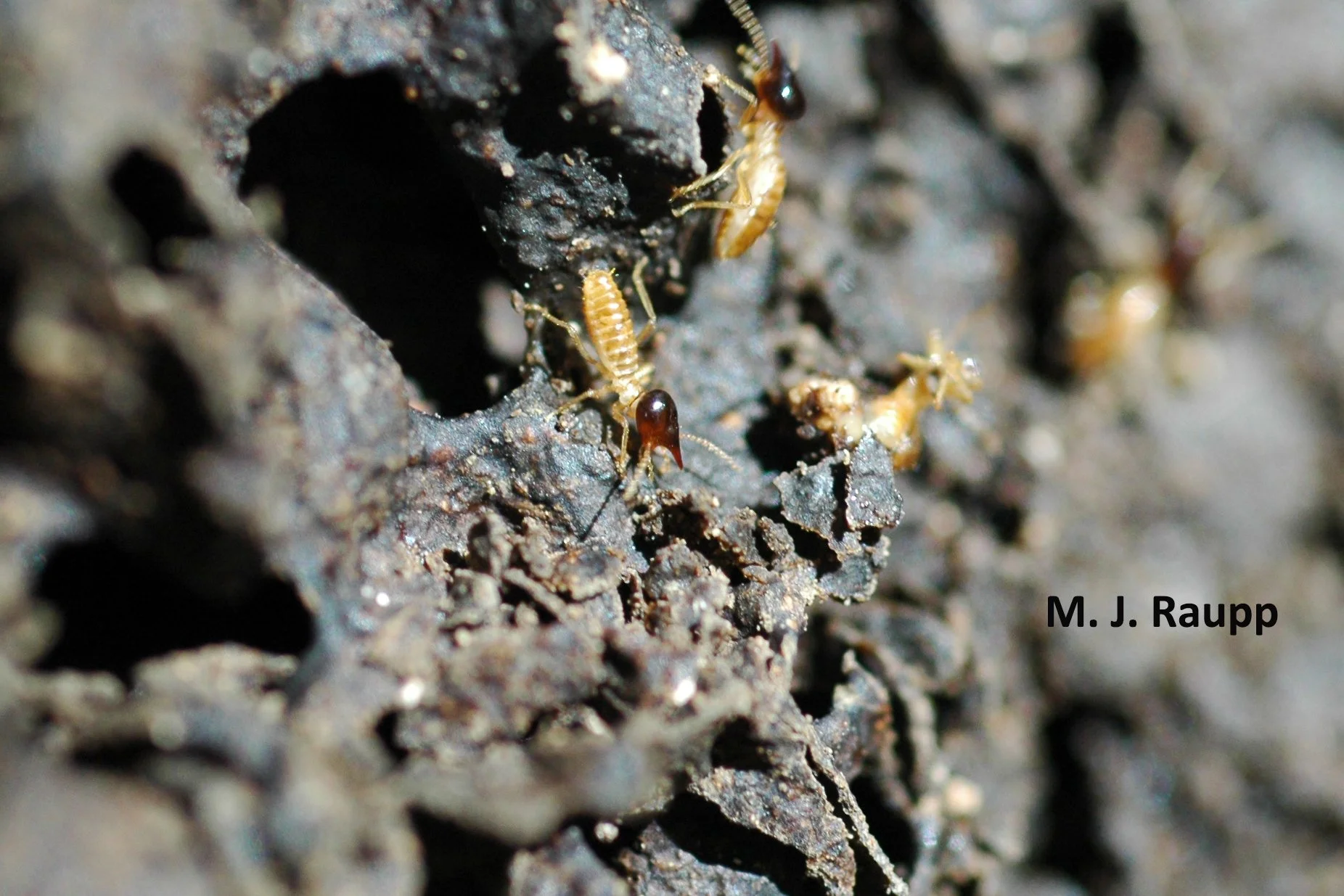
As the wicked winter tightens its grip on much of North America, let’s take another trip to somewhere warm. We recently visited pretty orchid bees, hungry leaf beetles, and squirty froghoppers in the cloud forest of Costa Rica. This week we travel some 800 miles north to the rainforest at Toucan Ridge, Belize. In this lush green paradise warm temperatures and abundant rainfall make this one of the most productive ecosystems on the planet. Rapidly growing trees and shrubs provide a bounty of food for legions of plant-eating insects, reptiles, birds, and mammals. However, these vegetarians alone cannot devour the enormous quantity of plant material produced. Plant debris would soon bury the jungle were it not for work of another group of plant eaters, the termites. Termites are remarkable creatures that consume both living and dead plant material in the tropics. To utilize the nutrients tied up in plants, termites rely on a hearty gut microbiome of symbiotic bacteria and, in some primitive species, protozoa, to help digest the refractory plant material called cellulose.
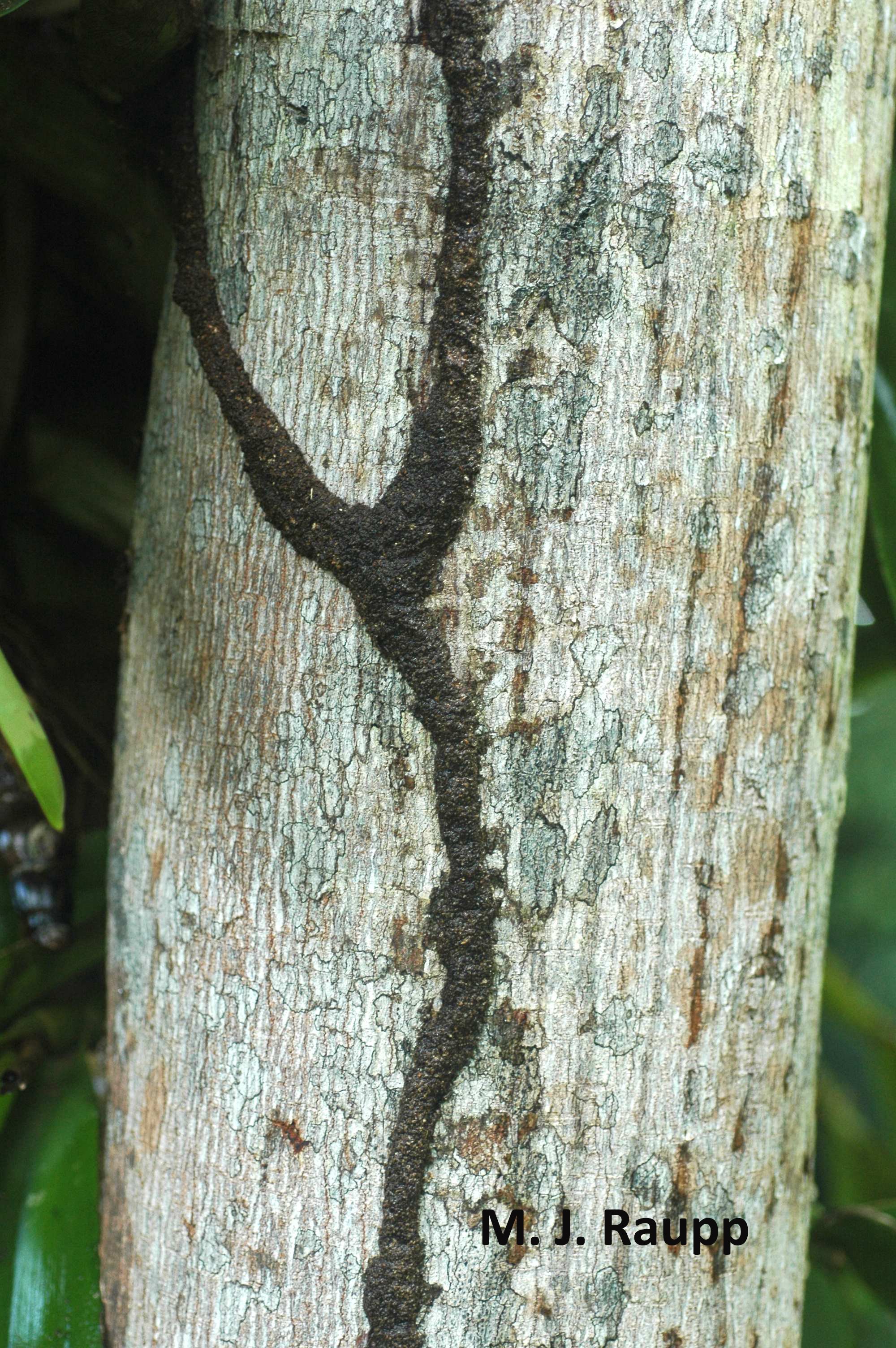
Dark trails of soil, wood particles, and feces mark the corridors used by sunlight-fearing termites to reach food sources in the canopies of trees.
Termites have an unusual and rather crude way of passing these vital microbes from one termite to the next through a process known as proctodeal trophallaxis. One termite excretes a droplet of microbe-packed fluid from its anus. This packet of goodies is consumed by another termite waiting at the rear end. Yum! The transfer of liquids from one termite to the next is also a way of disseminating chemical messages called pheromones that regulate the development and behavior of termites within the colony.
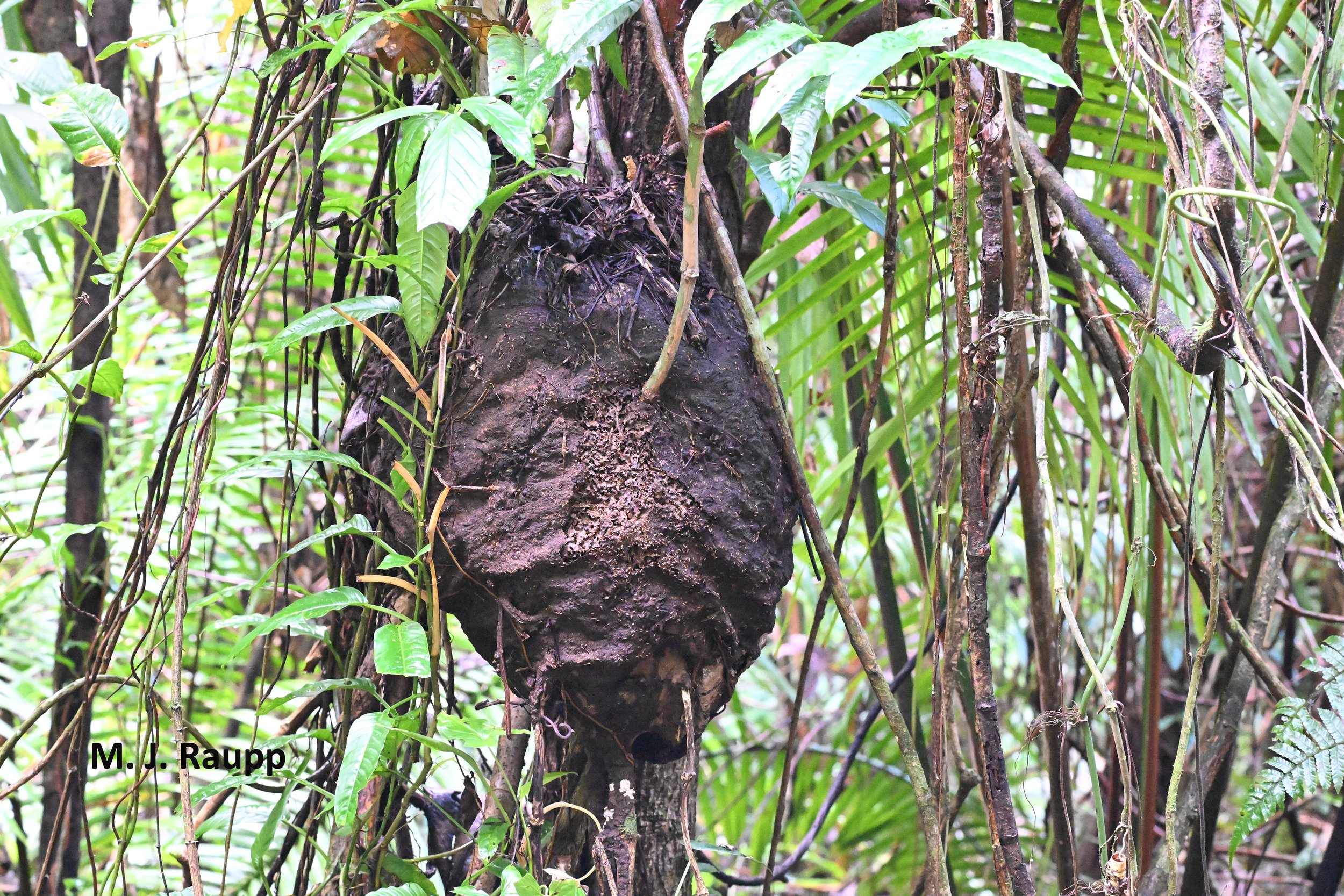
Strange, large, coffee-brown objects adorning trees in the rainforest are aerial nests of termites.
While adventuring along a slippery mountain trail with 18 adventurous students, we happened upon a large nest of conehead termites. Our local Belizean trail guide shared lore of the importance of termites to the ancient Mayan people. Mayans used termites as bait for fish in a way known only to them. Mayans crushed and smeared termites on their skin as a natural repellent for biting flies like mosquitoes. Mayans also consumed termites as a source of nutrients. Our Belizean guide invited us to sample termites to learn why so many insects, birds, and mammals seek a termite buffet.
Along a rainforest trail we encountered a large aerial termite nest. Our Belizean guide opened the nest and invited us to sample termites to learn why so many insects, birds, and mammals seek a termite buffet. By holding his hand against the hole in the nest, he collected several nozzle-headed soldiers that had issued forth to defend their colony. After our guide dined on a few, several bold students and one professor sampled the tiny defenders. After plucking a few workers from the colony and savoring each morsel, I found the delicate flavor reminiscent of carrots. Little wonder the Mayans enjoyed them. Others in our group did not share my assessment. Some quipped that termites tasted, well, like bugs.
To demonstrate this point, our guide made a platter-sized rent in the termite nest. By holding his hand against the hole in the nest, he collected several nozzle-headed soldiers that had issued forth to defend the nest. After our guide dined on a few, several bold students and one professor sampled the tiny defenders. After plucking a few workers from the colony and savoring each morsel, I found the delicate flavor reminiscent of carrots. Little wonder the Mayans enjoyed them. Others in our group did not share my assessment. Some quipped that termites tasted, well, like bugs.
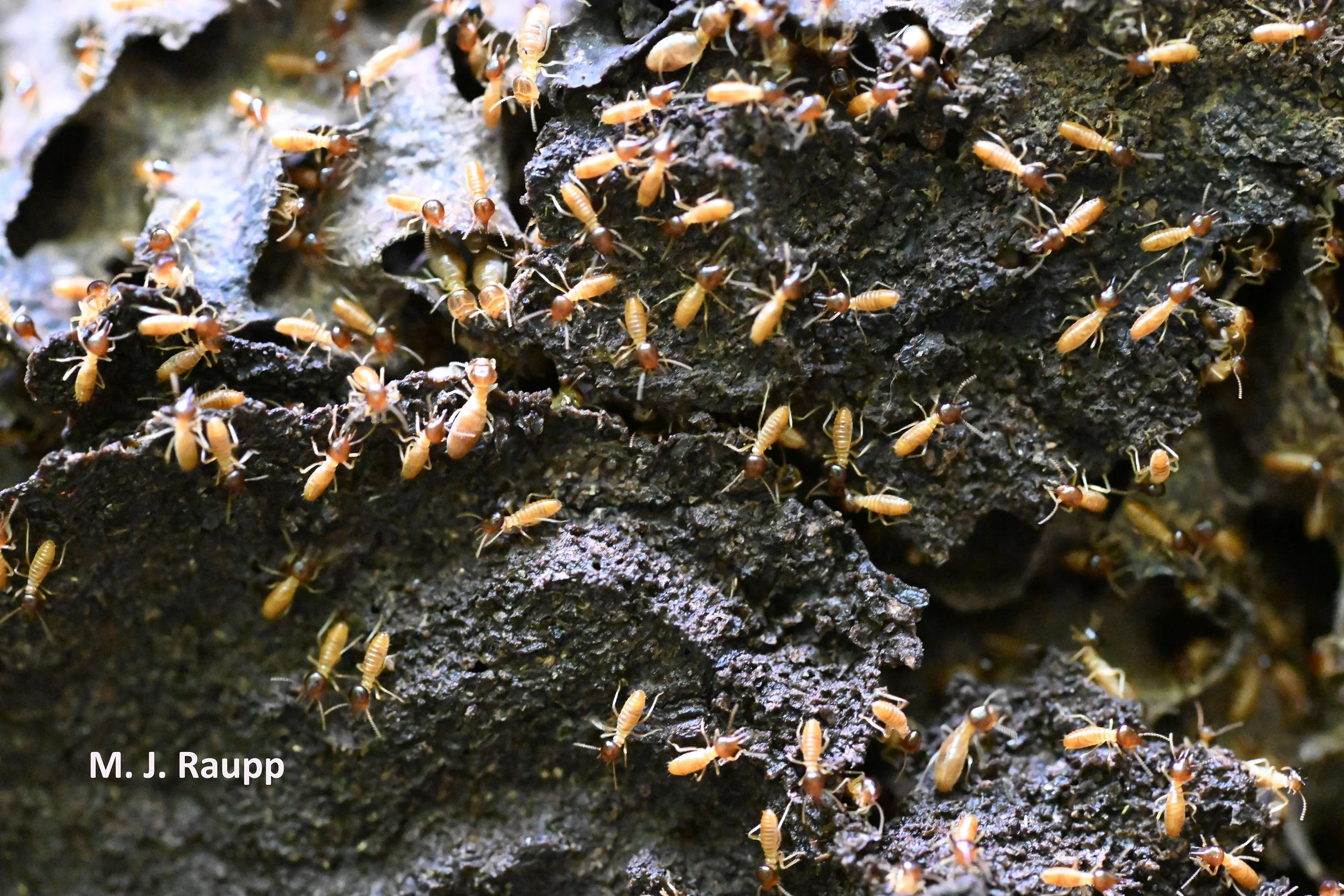
Scores of termite solders scramble to protect the colony when the outer protective shell has been breached.
Termites are part of an elite group of social insects that include the ants and several wasps and bees. Social insects such as termites and ants have a distinct division of labor with a caste system that includes specialized workers, soldiers, and reproductives. Termite reproductives are called kings and queens. These long-lived queens produce thousands and thousands of eggs during the course of their lives, which can span several decades. Termite queens are the longest lived of all insect species. Termite kings live only long enough to mate and they die soon thereafter. While Tom Petty lyricized that it was good to be king, from the longevity standpoint it’s better to be queen in the termite realm.
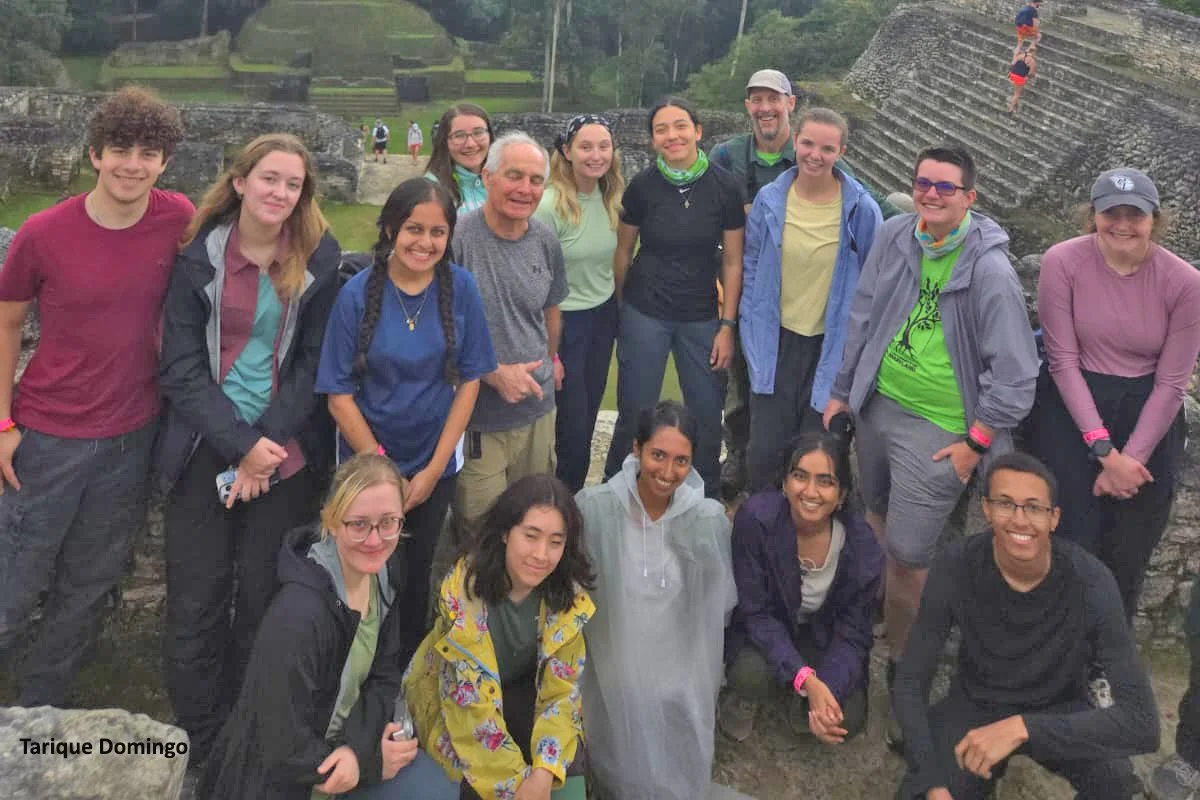
Atop the high pyramid of Caracol, students from the University of Maryland explore the wonders of tropical rainforests and Mayan civilizations. Image: Tarique Domingo
Acknowledgements
Bug of the Week thanks the adventurous students and faculty of BSCI 339M, Belize: Tropical Biology and Mayan Culture, for providing the inspiration for this episode. We thank our guides Will and Tarique for teaching us the ways of the Mayans. Special thanks to the staff of the Toucan Ridge Ecology and Education Society for allowing us to learn about insects in their rainforest reserve. Two great books, "The Insect Societies" by E.O. Wilson and “For Love of Insects” by T. Eisner, were used as references for this Bug of the Week.