This week we return to the tradition of visiting beautiful and fascinating insects bedecked in the Halloween colors of orange and black. The origins of Halloween began in the time of ancient Celts when summer ended and the time of harvest gave way to approaching winter. The start of the Celtic New Year on November 1 was a scary time, as spirits of the dead returned to earth on the eve of October 31 to visit family and engage in frightening tricks. Orange and black became the colors of Halloween, orange representing the color of harvest and later the Jack O’ Lantern, and black symbolizing the color of death. This week we meet butterflies and moths that advertise their potential lethality by displaying bright colors of orange and black like beautiful milkweed tiger moths and monarch butterflies we met in previous episodes.
To meet some of these beauties we visit a native herbaceous perennial, wingstem, Verbesina alternifolia, one of the most dependable attractors of pollinators. Since early August here in the DMV, wingstem has been busy providing nectar and pollen to a dazzling array of bees, wasps, beetles, butterflies, and moths. So, this week of Halloween, let’s briefly visit four showy Lepidoptera dressed in orange and black who make regular appearances on wingstem.
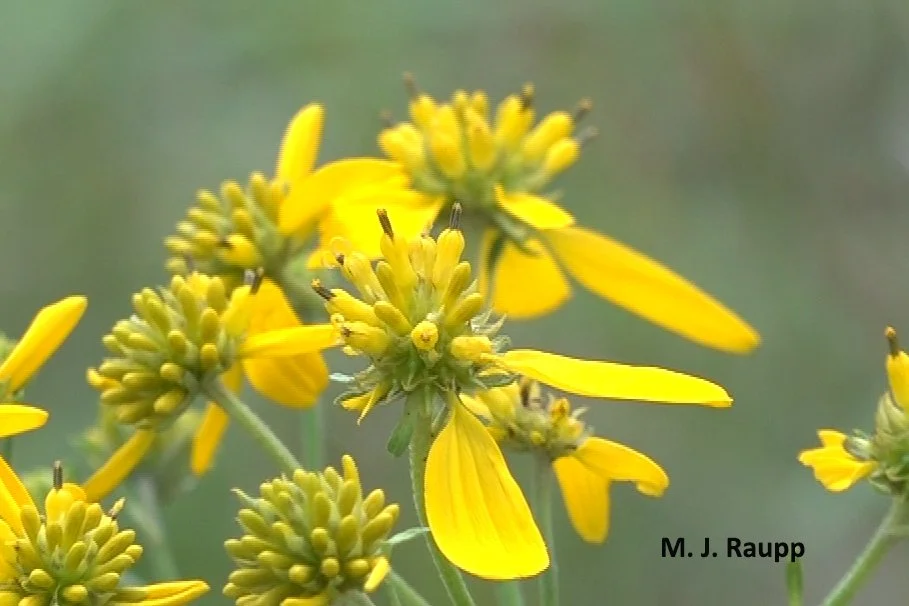
Wingstem, a beautiful native member of the aster family, is a dazzling attractor to an array of bees, wasps, beetles, butterflies, and moths during late summer and autumn.
The Ailanthus webworm moth dresses in a spectacular robe of white, orange, and black. Its brilliant contrasting colors are believed to advertise its distastefulness to predators by virtue of its ability to sequester noxious compounds from Ailanthus foliage consumed when it was a caterpillar. Unlike many nocturnal moths, Atteva aurea is a daytime visitor to wingstem. The female lays eggs in clusters on the leaves of the invasive Tree of Heaven, Ailanthus altissima. Caterpillars known as ailanthus webworms hatch from the eggs and build a communal web, from which they forage on the leaves. Small trees may be almost completely enshrouded by the nests of the webworm, and they may sustain almost complete defoliation. So efficient are the caterpillars at munching leaves of Ailanthus that some consider them a biological control agent for the invasive Tree of Heaven.
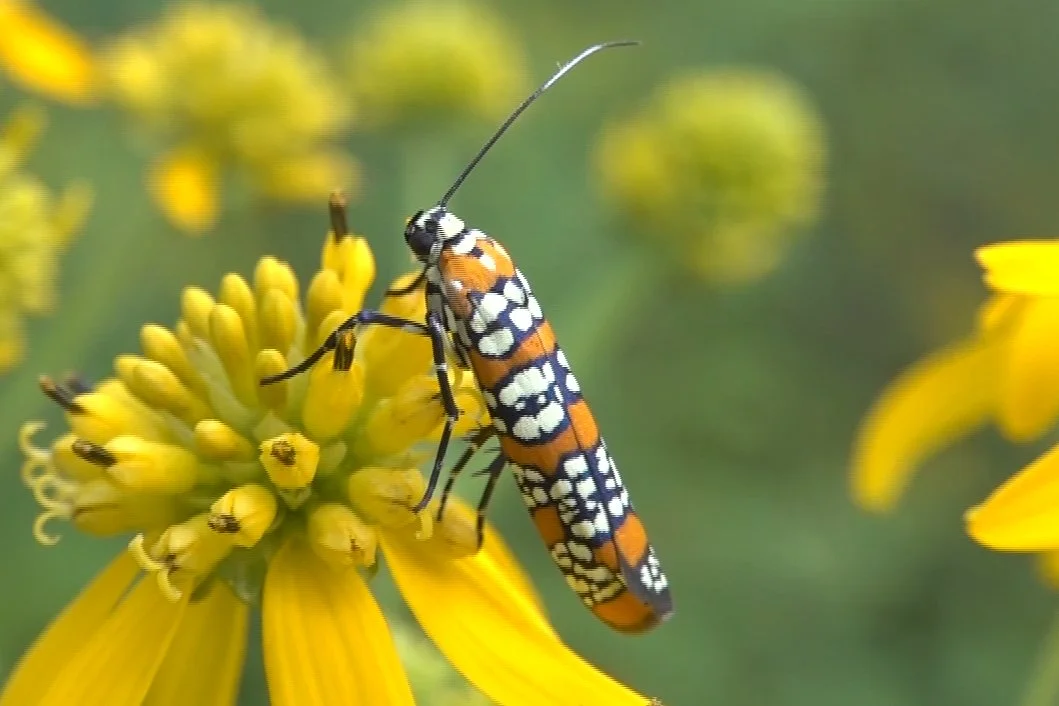
Ailanthus webworm moths wear colors of orange and black to warn predators that they might not be a happy meal.
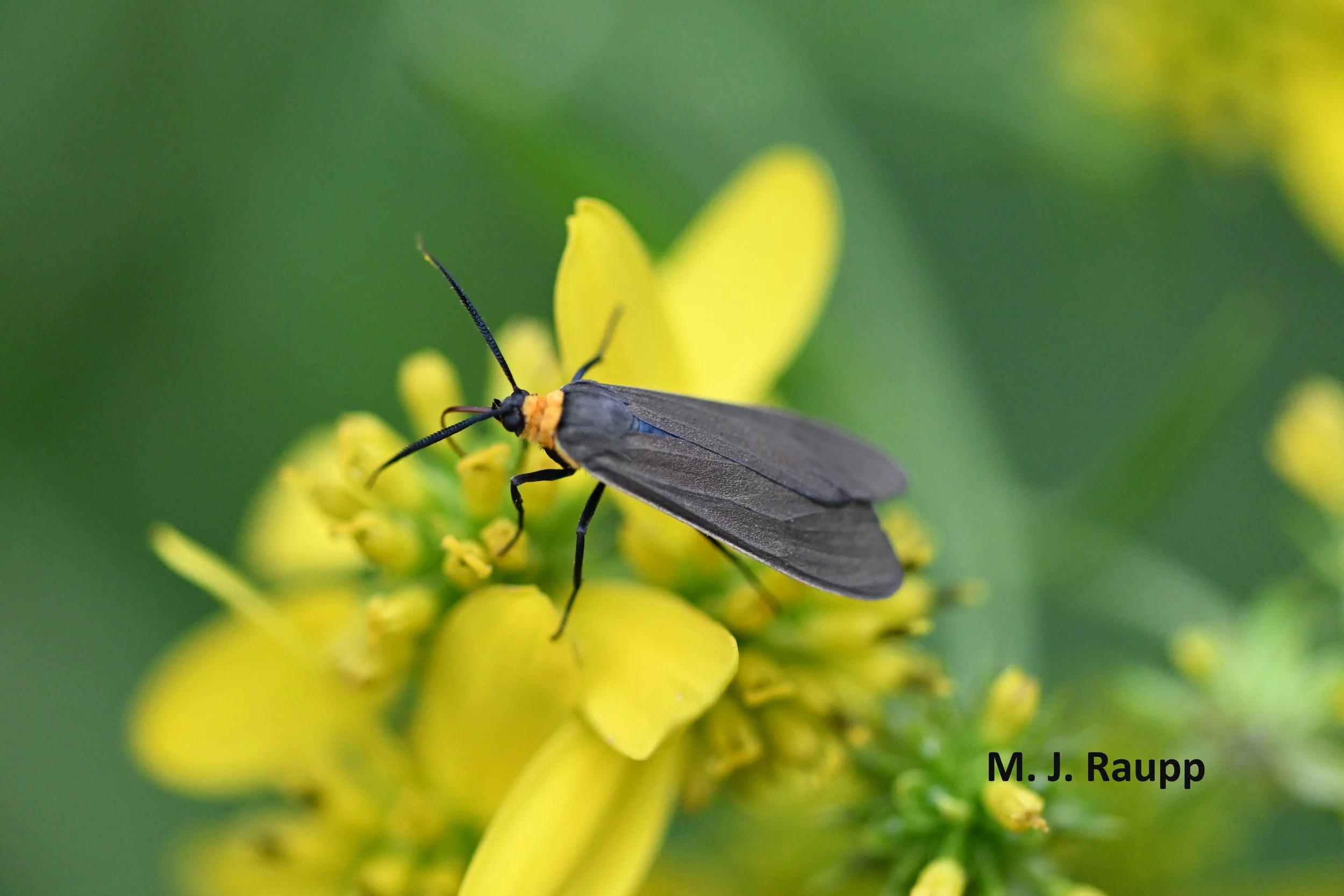
Another bold visitor to wingstem is the beautiful yellow-collared scape moth. This member of the tiger moth clan is a common visitor to gardens and meadows in late summer and autumn. Dressed in classic black with a bright orange or yellow collar, this moth may be seen feeding during the day, as well as after sunset. Scientists suggest that the scape moth’s warning coloration may be related to the presence of noxious alkaloids obtained from members of the aster family on which moths feed. The yellow-collared scape moth lays her eggs on grasses and sedges. The rarely seen scape moth caterpillars feed at night.
Just in time for Halloween, let’s visit some gorgeous moths and butterflies dressed in orange and black as they visit one of the premier native pollinator plants - wingstem. First up is the Ailanthus webworm moth. As the name implies, caterpillars of this beauty eat leaves of invasive Tree of Heaven. Our next visitor, the yellow- collared scape moth is a daytime feeder whose larvae eat leaves of sedges and grasses. The beautiful pearl crescent butterfly is a huge fan of wingstem and her caterpillar offspring dine on asters. Before beginning her long journey to the overwintering forests of Mexico, this pretty monarch butterfly tanked-up on wingstem in my meadow. Hope her trip is filled with treats and no tricks.
Another beauty in orange and black is the delightful pearl crescent, Phyciodes tharos. These small, active members of the brush footed butterfly clan may have as many as three generations in Maryland and up to six generations in Georgia and Florida. Adult pearl crescents feed on the nectar of a wide variety of plants including milkweed, dogbane, and Black-eyed Susan, as well as other members of the aster family in addition to wingstem. However, when it comes to food for her young, the female pearl crescent favors asters above all, where she deposits up to 700 eggs over the course of her lifetime. In temperate states like Maryland, hardy pearl crescent caterpillars brave the winter in a hibernation-like state called diapause and complete their development in spring when warm weather and succulent leaves return.
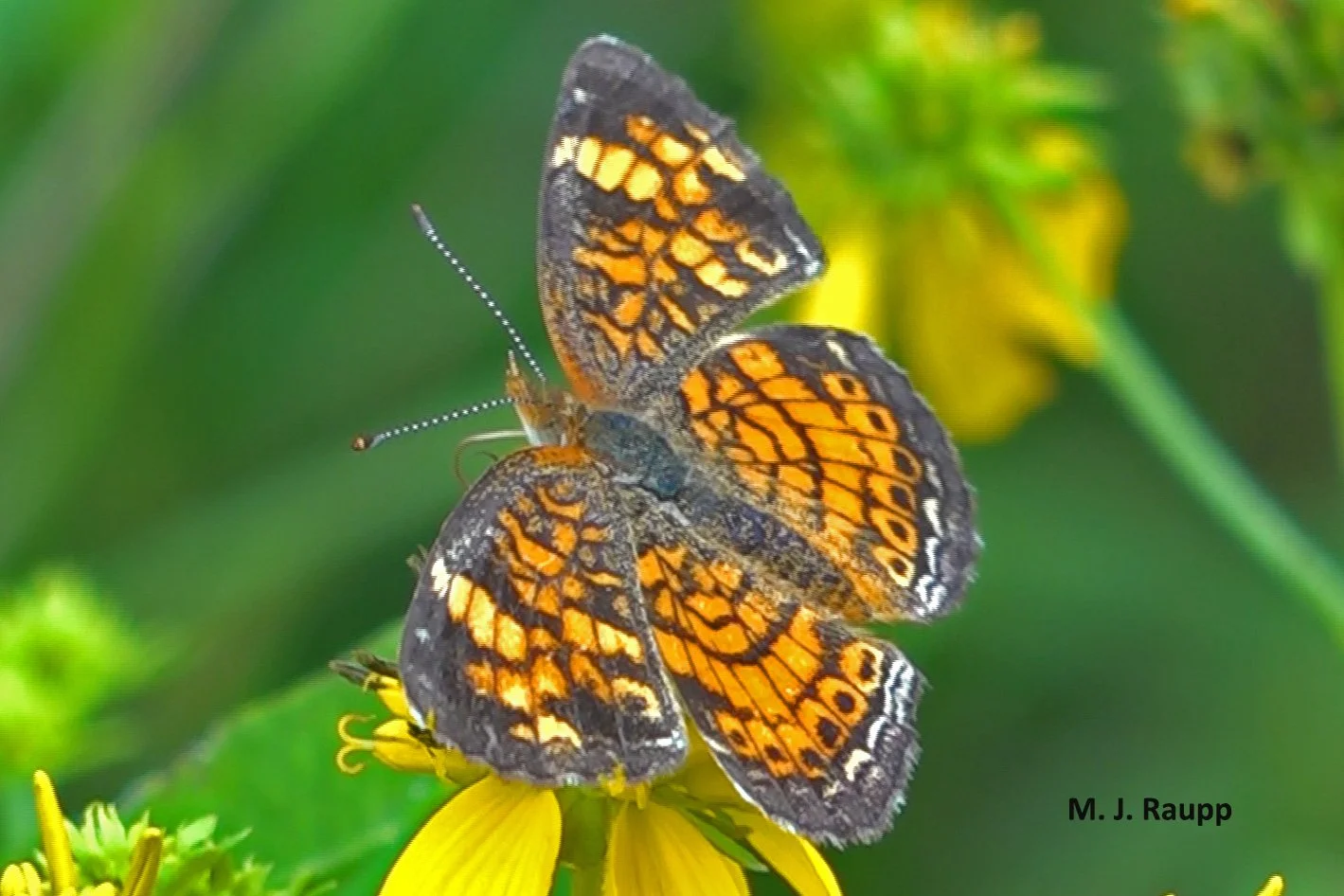
Pearl crescent butterflies are regular visitors to wingstem.
Finally, our friend the monarch butterfly stopped by to tank-up on the carbohydrate rich nectar of wingstem before beginning its long journey to the overwintering forests in Mexico.
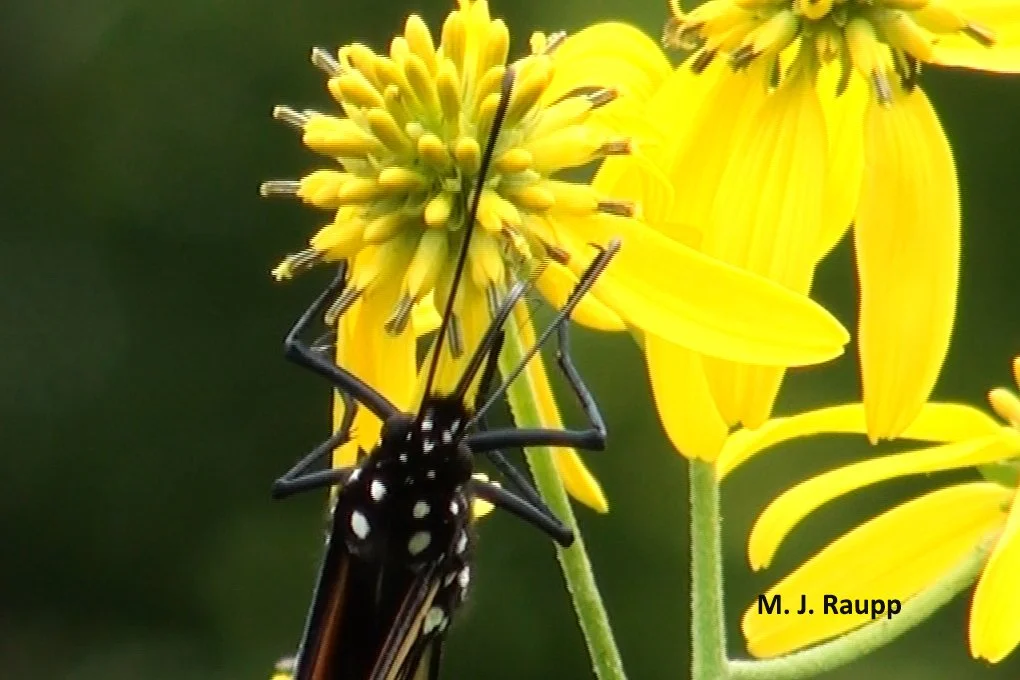
This monarch butterfly stopped to tank-up on wingstem nectar before heading south for the winter.
Acknowledgements
Interesting references used for this Bug of the Week include “Ecology of the center city, Philadelphia” by K. D. Frank, “The Insects: An outline of entomology” by P.J. Gullan and P.S. Cranston, “Assessing potential biological control of the invasive plant, tree-of-heaven, Ailanthus altissima” by J. Ding, Y. Wu, H. Zheung, W. Fu, R. Reardon, and M. Liu, “Sound strategy: acoustic aposematism in the bat–tiger moth arms race” by Nickolay I. Hristov and William E. Conner, and “Secret weapons” by Thomas Eisner, Maria Eisner, and Melody Siegler were used in preparation of this story.