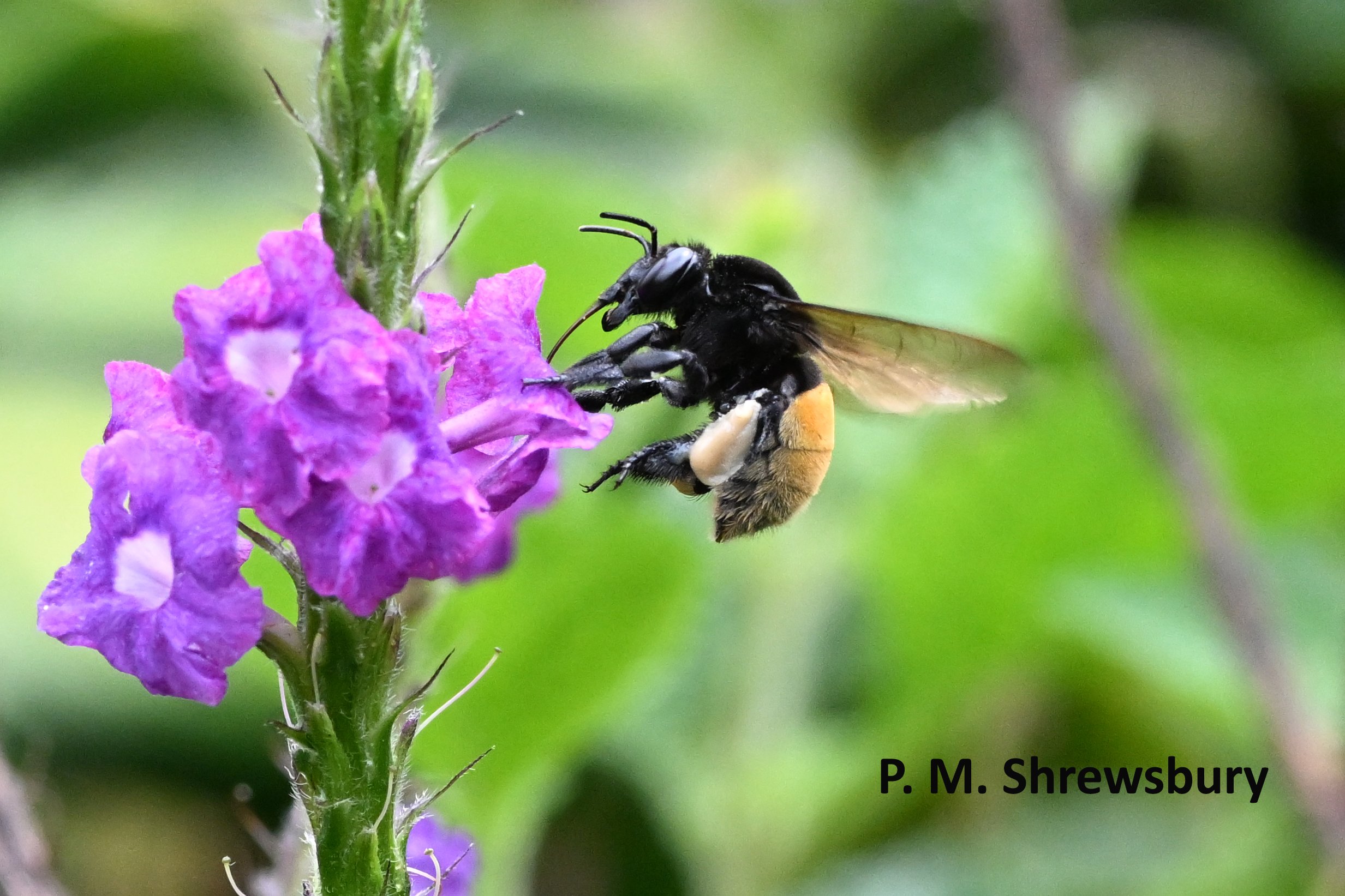
This week we return to the mystical cloud forest of Monteverde Costa Rica where, in the last two episodes, we met beautiful golden frog hoppers and rolled-leaf hispine beetles that make beautiful heliconia plants their meal and home. In a stylish landscape along a high mountain road, we saw some large busy bees visiting beautiful purple porterweed. At first glance these appeared to be busy bumblebees, but with a little help from iNaturalist, we learned that these were large orchid bees in the genus Eulaema. In addition to pollinating porterweed, large orchid bees, including Eulaema, are important pollinators of a wide variety of orchids including one of my favorites, the second most expensive flavoring in the world, vanilla. While female orchid bees collect massive loads of pollen to feed their young, male orchid bees have evolved remarkable morphological structures and equally clever behaviors to woo their mates. On a section of their hide leg called the tibia, males evolved a greatly expanded hollow pouch. This hollow pouch has an opening to the air to release fragrances called perfumes. Let’s see what this is all about.
Here's a little backstory. In the dating game of humans, odors make a difference. Does anyone really want a stinky partner? Apparently not. For centuries humans have used fragrances to grab the attention of a potential mate. The global perfume industry is valued at more than 50 billion dollars annually. Guess what, male orchid bees have also figured out that the right odor can make you a winner in the mating game.
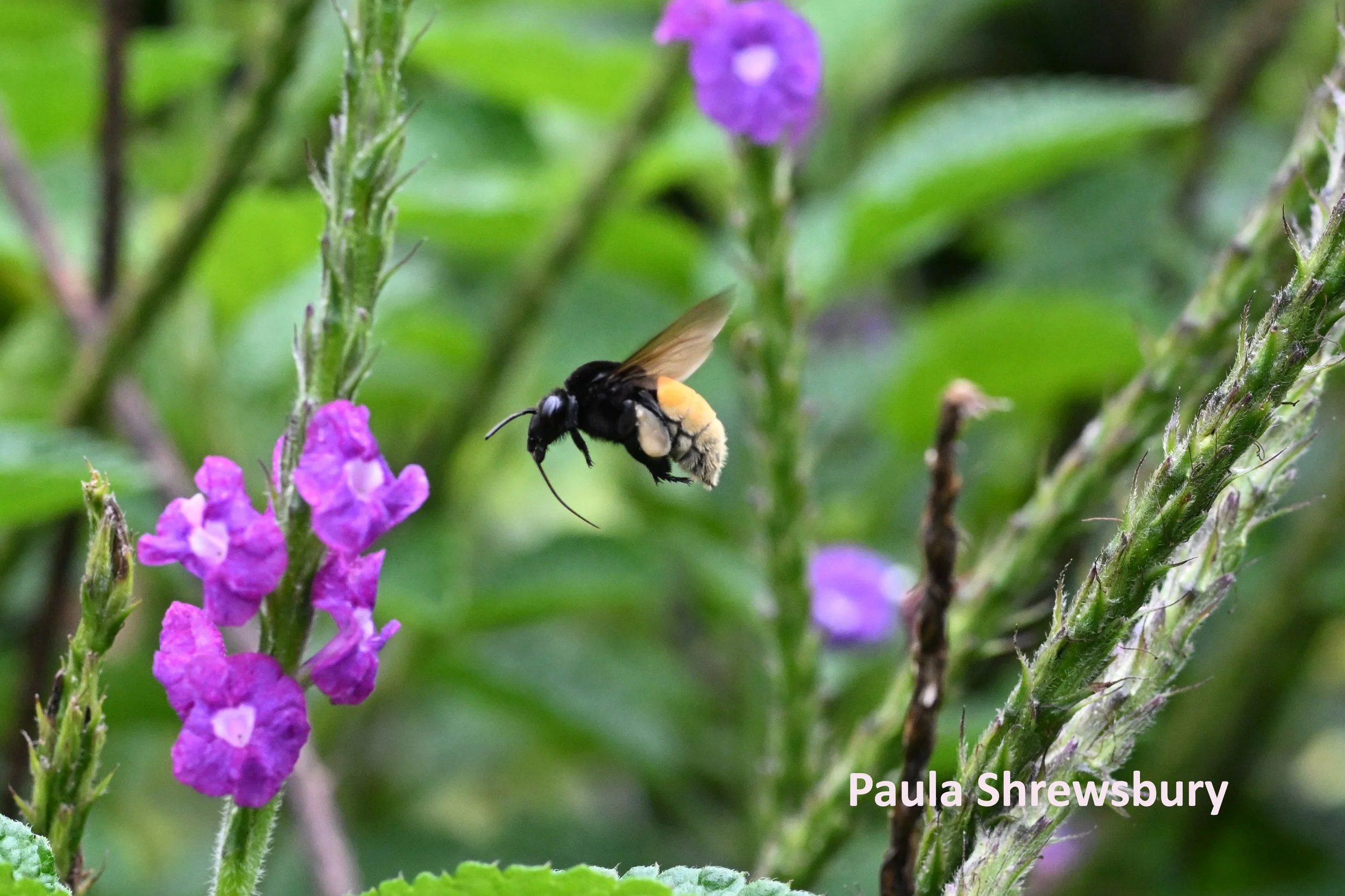
Even in flight Eulaema has its proboscis ready for action.
Male orchid bees visit sources of volatile scents in a wide variety of places including flowers, tree sap, resin, fungi, and other places to collect several different fragrances. How do they collect these perfumes? Male bees secrete droplets of lipid compounds from their mouthparts onto the surface of a flower or other source of odors. Various scented compounds are absorbed into the lipid droplets. These droplets are then collected and stored in the hollow chamber of the expanded tibial pouch of the hind leg. During courtship the male orchid bee fans its wings, causing the fragrances stored in the hind leg to become airborne. The unique blend of the male’s perfumes attracts potential mates, enabling female orchid bees to recognize males of her species and to choose that special someone to be the father of her offspring. I must wonder if orchid bees have a lesson here for us.
In the cloud forest of Monteverde, large bees visit purple porterweed. Although resembling bumble bees, these beauties are orchid bees in the genus Eulaema. In addition to pollinating porterweed, Eulaema pollinate a wide variety of orchids including one of my favorites, vanilla. They sip nectar through a remarkably long proboscis, also called a tongue. While female orchid bees collect massive loads of pollen to feed their young, male orchid bees collect fragrances from many sources and store them in perfume pouches on their hind legs. To attract a mate, the male bee fans its wings, releasing his perfume into the air. Female orchid bees use these odors to recognize males and choose just the right mate to father their offspring.
Acknowledgements
We thank Paula Shrewsbury for sharing her pretty images of Eulaema foraging on porterweed in the cloud forest. Two fantastic articles “Evolution of Acquired Perfumes and Endogenous Lipid Secretions in Orchid Bees” by Thomas Eltz, Tobias Mende, and Santiago Ramírez, and “Non-floral scent sources of orchid bees: observations and significance” by Jonas Henske, Bart P. E. De Dijn, and Thomas Eltz were sources of information for this article.