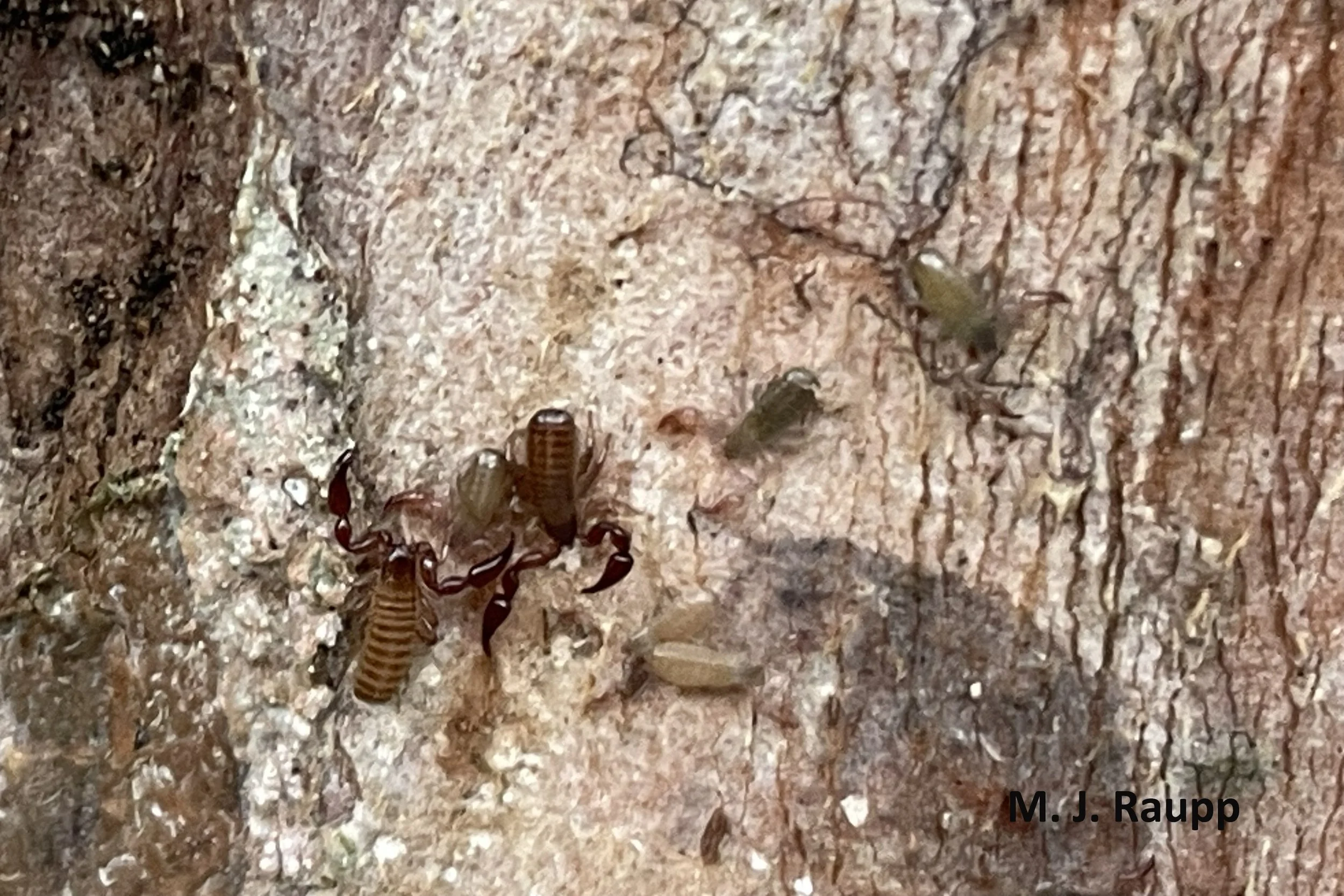
This week we continue our adventure in Belize where we previously met tasty termites, pretty peacock butterflies, and stinging scorpions. On the bark of an ancient sapodilla tree, we spotted a busy colony of tiny scorpion-like creatures milling about on the surface of the trunk. These tiny arachnids had impressive pinchers known as pedipalps that closely resembled those of their distant cousins, scorpions. Pedipalps of many pseudoscorpions contain venom used to paralyze prey prior to being dismembered and consumed. They secrete proteolytic enzymes designed to predigest their victims before slurping up the liquified tissues of their prey. I’m glad they are not as big as wolves.
On the bark of an ancient rainforest tree a colony of adult pseudoscorpions with dark pinchers and bodies mingled with their lightly colored offspring. Lacking stingers like their cousins, true scorpions, pseudoscorpions rely on venomous pinchers to subdue and dismember prey.
Beyond the much smaller size of pseudoscorpions compared to their true scorpion kin (most pseudoscorpions are less than 8 mm long), the most striking difference is the absence of the elongated tail and painful stinger of the true scorpion. The abdomen of the pseudoscorpion is slightly rounded. Some species are known to travel about by hitching a ride attached to the body of another insect like a fly or a beetle in a behavior known as phoresy. In addition to the rainforests of Belize, pseudoscorpions can be found in homes right here in the DMV where they hunt booklice, carpet beetle larvae, mites, and other minute arthropods found in and around homes. While these curious creatures pose no threats to humans or pets, they are fierce and interesting members of a miniature world in the tropical rainforest.
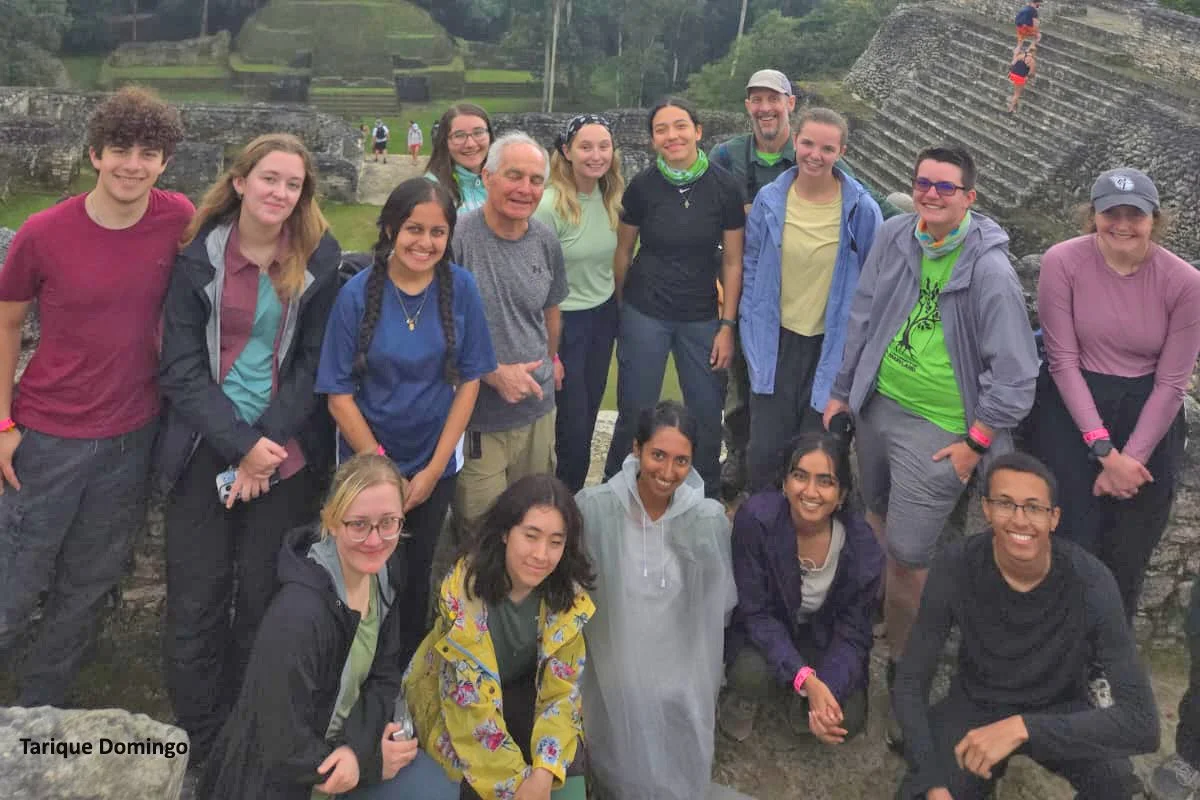
On the steps of a pyramid at Caracol, students from the University of Maryland explore the wonders of tropical rainforests and Mayan civilizations. Image: Luis Godoy
Acknowledgements
The interesting articles “Pseudoscorpions” by Jeffrey Hahn and “Pseudoscorpions of the World” by M. S. Harvey were used as references for this episode. We thank the hearty crew of BSCI 339M, Belize: Tropical Biology and Mayan Culture and our fearless guide Luis Godoy for providing the inspiration for this episode.