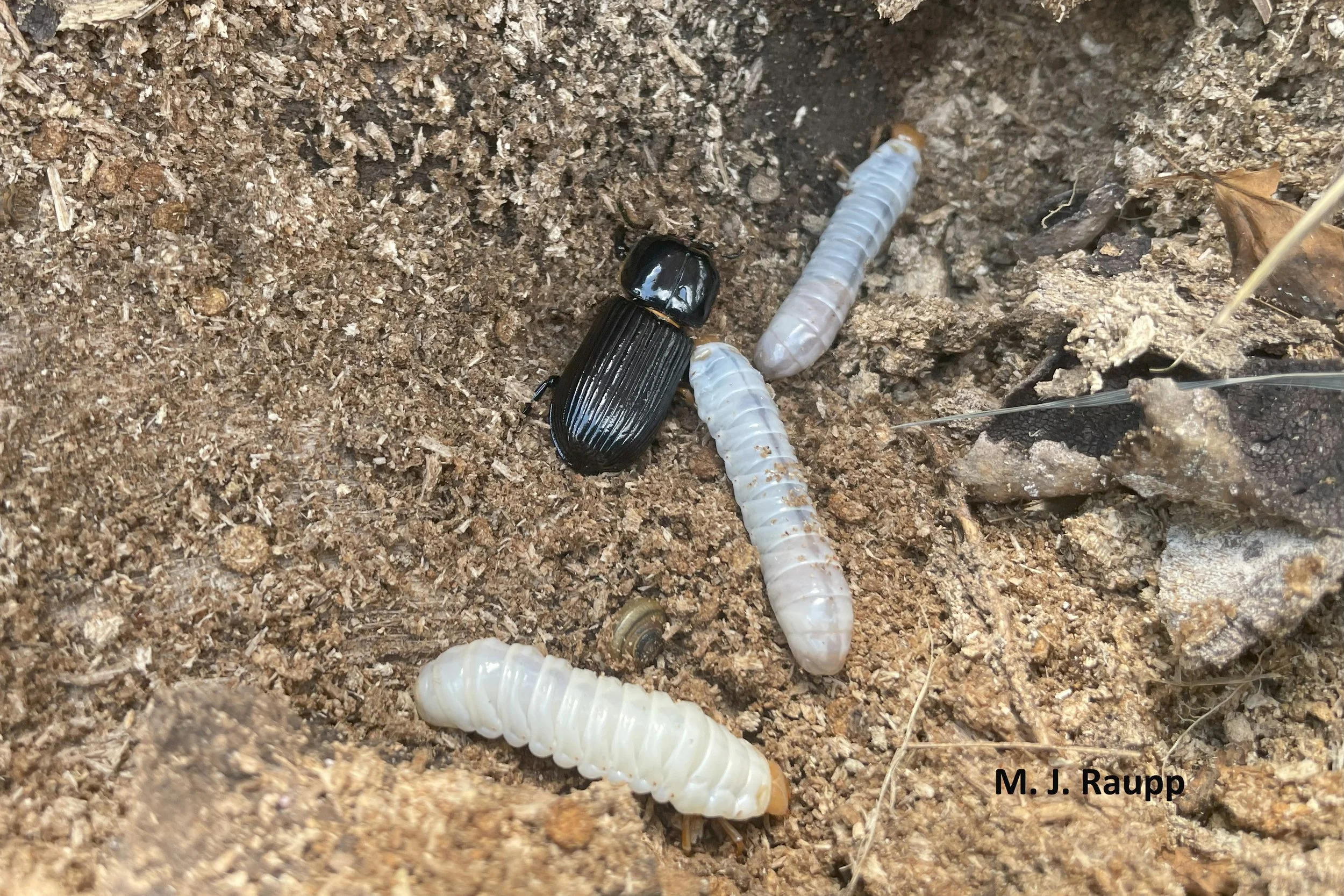
A week or so ago, a friend sent me a short video of a beautiful bess beetle (aka, horned passalus beetle, betsy beetle, bess bug) and I marveled at the wonderful sound it made. A quick dive into the literature revealed that the sound is produced when the beetle flexes its abdomen, which causes a file-like structure on the upper surface of the abdomen to rub against a toothed structure, called the scraper, on its hind wings. This remarkable song has been described as chirping or screeking. It is called stridulation and is seen in many members of the insect clan. We met large stridulating beetles in Borneo in a previous episode. More than a dozen distinct types of stridulation have been identified in bess beetles.
Bess beetles sing by rubbing their abdomen on their hindwings. This sound, called stridulation, is used for defense and communication among adults and their offspring. Video by Peihan Orestes.
Other than amusing humans, does sound production via stridulation serve other purposes for bess beetles? One possibility is that vibrations and sounds made by bess beetles may be a defense against predation. A fascinating study by Dr. Buchler et al. found that stridulation by bess beetles disrupted attacks by crows. Other studies by Dr. Robinson and colleagues found that defense stridulation by one bess beetle caused other bess beetles to have a “freeze” response rather than a “fight or flight” response. In addition to serving as a defense, stridulation in bess beetles is thought to serve other functions including social interactions among other bess beetle adults and larvae. Bess beetles belong to a select group of insects known as subsocial insects. Beneath the bark of trees, they live in closely related groups of adults that cooperate in parental care including feeding, communication, and defense of larvae. And it is not only adult beetles that produce sound. Bess beetle larvae have highly modified hind legs on their thorax that produce sound when rubbed against the middle pair of legs. Stridulation by larvae is used to solicit food from adult beetles.
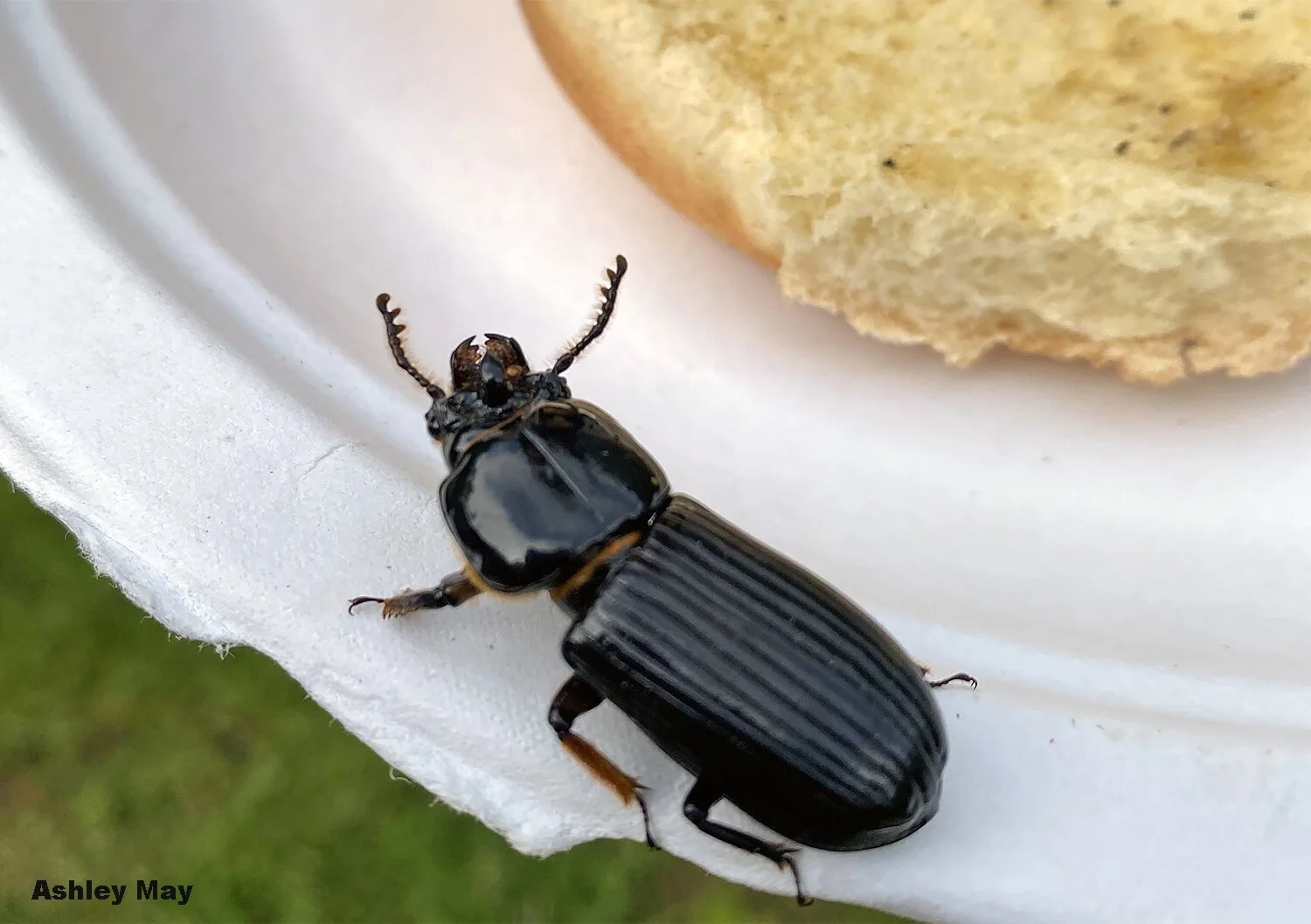
Dilemma for a bess beetle at a picnic, “Do I go for the hamburger bun or find a dead tree to eat?” Image credit: Ashley May
These powerful beetles are important participants in the great circle of life. No, they do not occupy an exalted place at the top of the food chain like Mufasa, the Lion King. They sit near the bottom of the heap along with fungi and bacteria, where they help decompose fibrous wood. Adult bess beetles use strong jaws to gnaw and ingest wood. After being processed in the beetle’s digestive system and deposited back in the wood, the microbe-packed droppings, aka frass, are consumed by bess beetle larvae. The microbes contained in the leavings of the adult beetles are particularly important for young larvae that require parental microorganisms to help them digest wood. Tough plant tissues such as lignin and cellulose are indigestible to us, but the gut microbiome of the bess beetle and resident microbes found in decaying wood enable bess beetles to capture nutrients as they recycle tough plant polymers. Now is a great time to observe bess beetles as they scramble across the forest floor or recycle wood beneath the bark of fallen trees.
Bess beetles are among the champion recyclers of the insect world. A remarkable microbiome in their gut enables bess beetles to break down tough polymers found in wood and extract nutrients locked up inside. Now is a great time to observe bess beetles as they scramble across the forest floor or recycle wood beneath the bark of fallen trees.
Acknowledgements
We thank Peihan Orestes for providing the cool video of her singing bess beetle that provided the inspiration for this episode. Thanks also to Ashley May for sharing the picture of the bess beetle that joined her picnic. These remarkable references were consulted to prepare this episode: “Super-Protective Child-Rearing by Japanese Bess Beetles, Cylindrocaulus patalis: Adults Provide Their Larvae with Chewed and Predigested Wood” by Tatsuya Mishima, Noriko Wada, Ryûtarô Iwata, Hirosi Anzai, Tadatsugu Hosoya, and Kunio Araya; “Is disturbance stridulation in the passalid beetle Odontotaenius disjunctus a form of social communication?” by K. M. Robinson, Z. C. Mabry, H. Schonekas, K. Y. Robles López, A. N. Johnson, G. Cipriani, A. Nguyen, C. H. Ziemke and K. M. Baudier; “On the functions of stridulation by the passalid beetle Odontotaenius disjunctus (Coleoptera: Passalidae)” by E.R. Buchler, T.B. Wright, and E.D. Brown; and “Disturbance Sounds of Adult Passalid Beetles (Coleoptera: Passalidae): Structural and Functional Aspects” by Pedro Reyes-Castillo and M. Jarman.