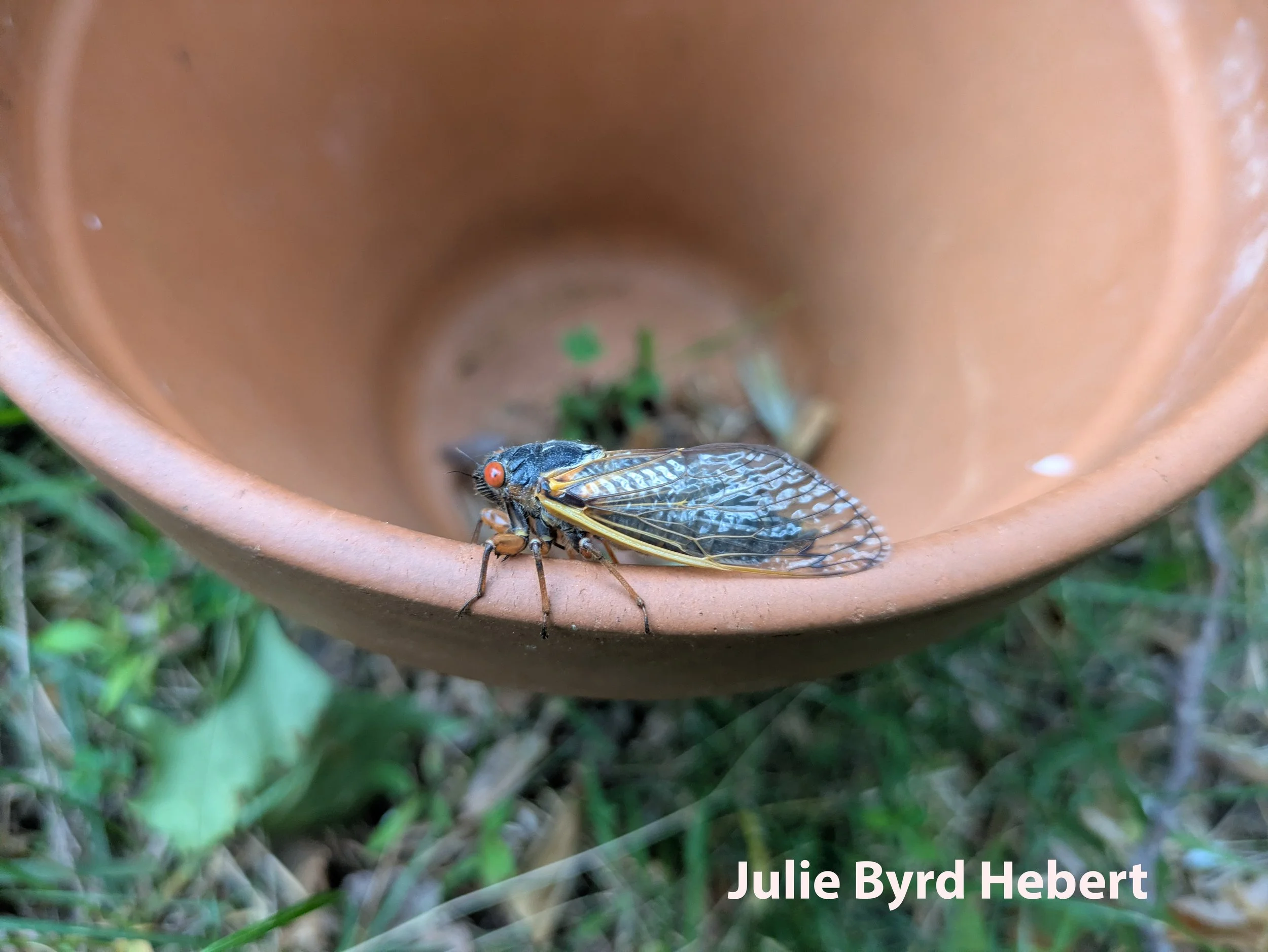
A mere five years ago, in the spring of 2021, cicada lovers exulted in the arrival of billions of periodical cicadas in the eastern United States. By mid-June as the party wound down, they bemoaned the fact that in most of the DMV these strange and magnificent creatures would not return until the spring of 2038. But guess what, last week I received some amazing images of periodical cicadas emerging in droves just outside of Charlottesville, Virginia.
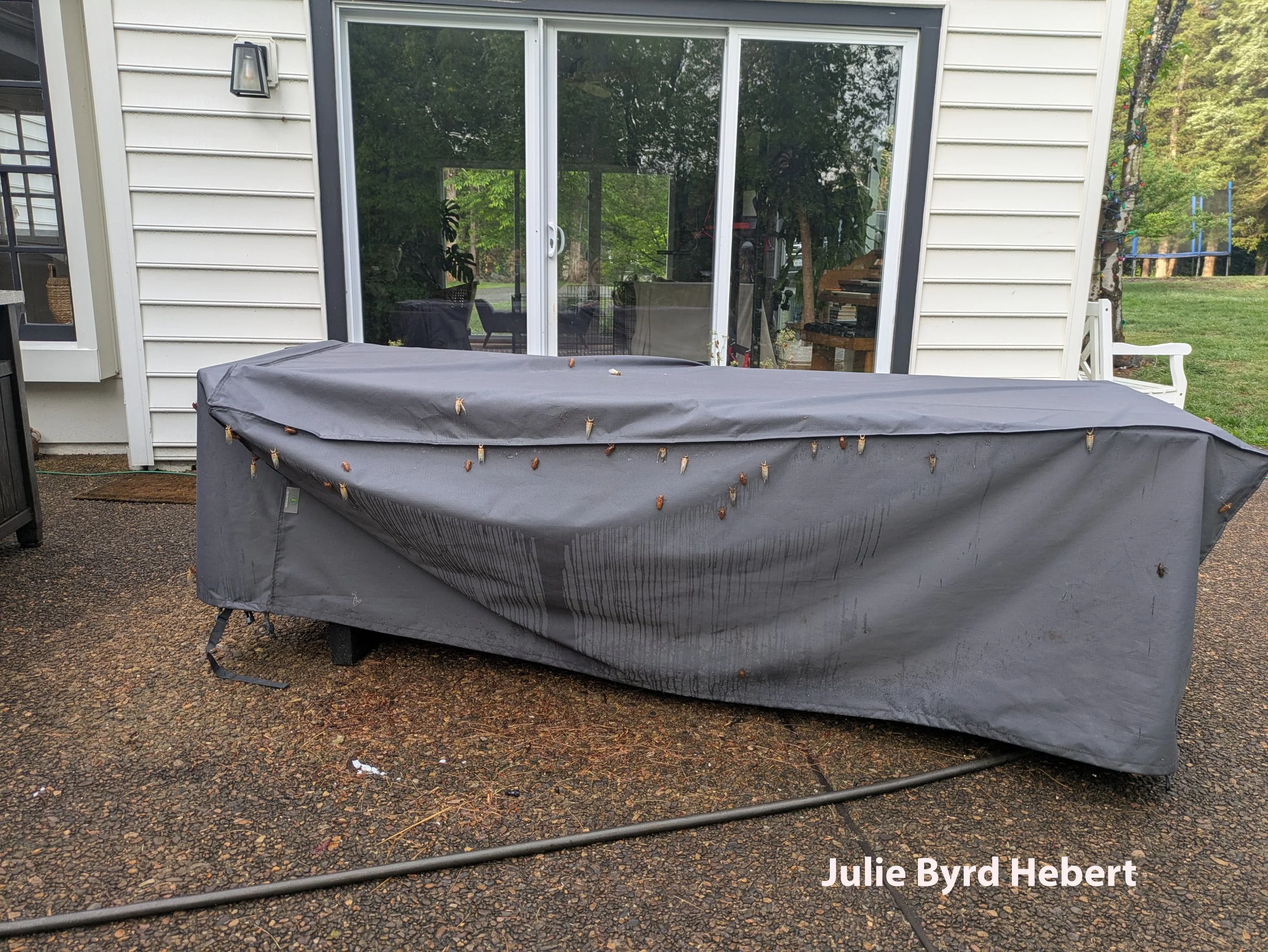
A surprise of Brood II periodical cicada stragglers greets homeowners in the Charlottesville, VA, region and several states east of the Mississippi. Image credit: Julie Bryd Hebert
This sighting mirrors more than 400 reports of cicadas in more than a dozen states in the eastern half of the US. These off-cycle sightings of periodical cicadas are part of the ongoing mystery surrounding one of Nature’s most magical creatures. Before local cicadaphiles get their hopes up too high and cicadaphobes start packing to leave town, please know that this is not the full-blown cicadapalooza of 2021 (Brood X) or 2024 (Broods XIX and XIII). According to CicadaMania, early rising cicadas of Brood II may be seen in parts of Connecticut, Georgia, Maryland, North Carolina, New Jersey, New York, Oklahoma, Pennsylvania and Virginia. And in Kentucky, Louisiana, Mississippi, and Ohio, some one-year-early Brood XXII cicadas may be seen. In all of these off-cycle appearances, densities usually are orders of magnitude less than those seen when cicadas emerge with the full complement of their broodmates.
Cicada stragglers are cicadas that emerge off-cycle from the rest of their massive brood. This poor guy emerged in 2022 and missed the big party in 2021 with billions of his Brood X broodmates that emerged in the Eastern United States that year. Here is what I saw on a spring morning in 2022. Against the background calls of Canada geese and mallard ducks, a male Brood X cicada scales an ancient maple tree in the early morning light. Watch as this lonesome bachelor avoids entanglement in a spider’s web. Instinct drives his quest to find a mate. Little does he know that his chances of passing along his genes to the next generation are between slim and none.
Cicada experts call sightings of cicadas in “off” years, cicada “stragglers.” Stragglers are periodical cicadas that emerge in years prior to or after the year that massive numbers of their broodmates emerge. Often, cicada stragglers emerge four years prior to or after their expected emergence date; however, it is possible for periodical cicadas to emerge between 8 years earlier or 4 years later than expected. Based on historical data, researchers can associate stragglers with their massive parent brood. The map accompanying this episode from iNaturalist provides accounts of actual sightings of periodical cicadas in our region this spring. This wonderful event has entomologists eager to add new information to our knowledge of these inimitable creatures. Recent studies conclude that the remarkable life cycles of periodical Magicicada are the interplay of genetic internal clocks and developmental growth thresholds that synchronize the emergence in 13- and 17-year cicadas. Experts suggest that part of the straggling phenomenon may be related to environmental factors such as variation in thermal regimes or the quality of the host trees immature cicadas dine on while underground. Sadly, densities of stragglers in an area may not achieve a quorum great enough to overwhelm hungry predators and other foes, and their unfortunate off-cycle appearance leads to oblivion for their progeny.
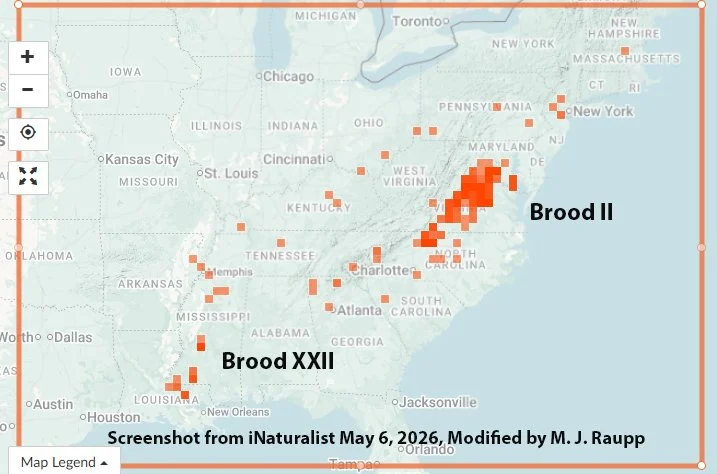
This recent map compiled from data sent to iNaturalist shows locations where Broods II and XXII stragglers have been seen this spring. Screenshot of iNaturalist May 6, 2026. Modified by M. J. Raupp
So, cicadaphiles, don’t despair, as this spring provides yet another chance to enjoy cicadas and to help scientists learn more about these creatures. You can participate in the highly successful community science project that has resulted in hundreds of thousands of data points by joining the Cicada Safari. To be part of the action, go to the app store on your cellular phone and download the Cicada Safari app. It is free and very easy to use. Download, register, and start snapping pictures of cicadas. Easy as pie. Cicada geniuses will vet your images and add them to a growing database designed to demystify the seasonal phenology and distribution of these charismatic creatures. Over the next several weeks as you enjoy parades, cookouts, and adventures in the great outdoors, keep your cell phones handy, eyes open and ears on the ready, and snap some shots of straggling Brood II and Brood XXII cicadas.
Acknowledgements
We thank Dr. Julie Byrd Gene Hebert for providing images and commentary of recent cicada sightings that were the inspiration for this episode. To learn more about magical periodical cicadas, please visit the fabulous repository for all things cicada at Cicada Mania and search the archives at Bug of the Week for “cicada’”. The fascinating articles “Advances in the Evolution and Ecology of 13- and 17-Year Periodical Cicadas” by Chris Simon, John R. Cooley, Richard Karban, and Teiji Sota, and “Decoding the periodical cicada clock: field evidence and genomic insights” by Zhenyong Du and Hu Li provided great insights for this episode.