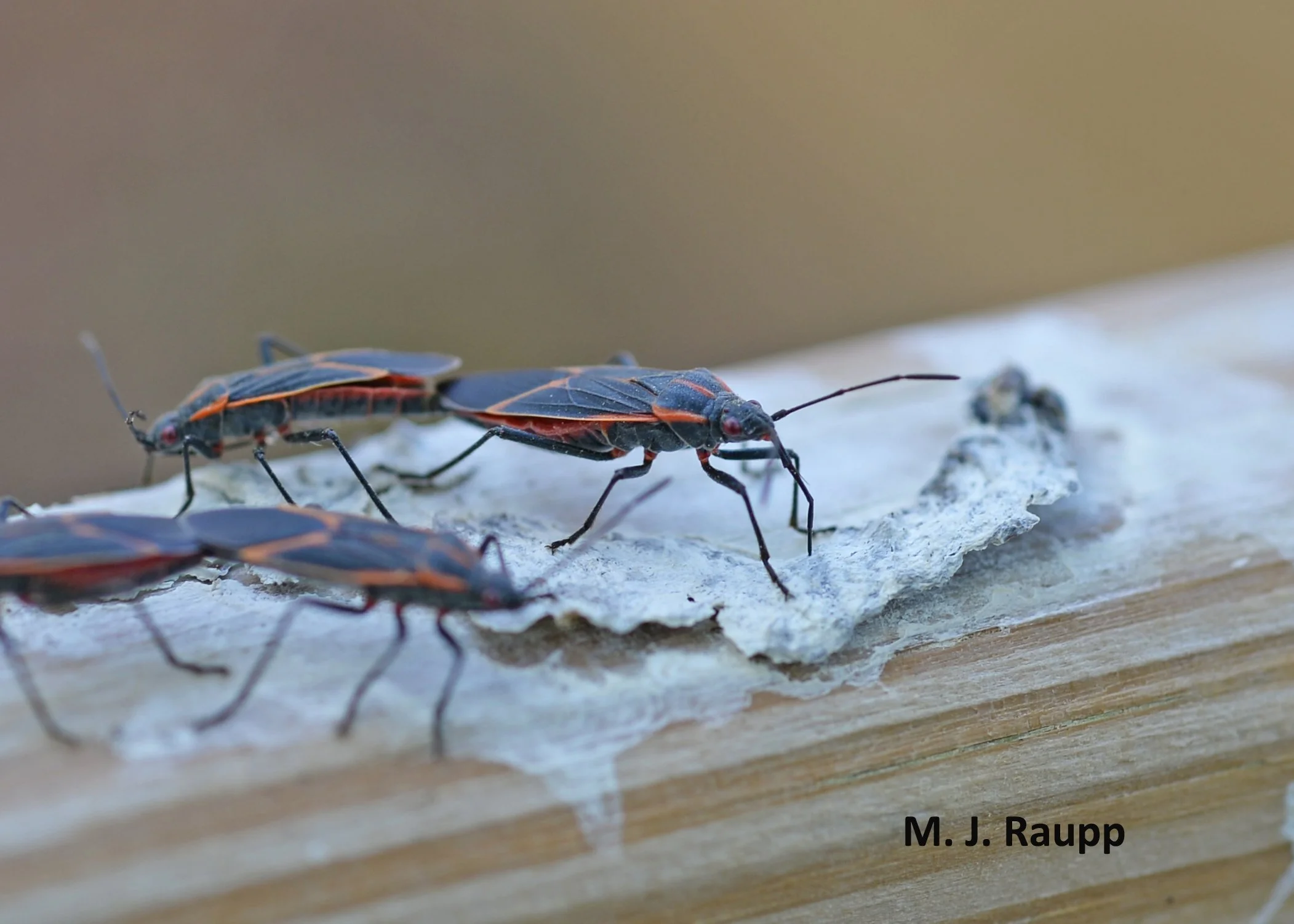
A few weeks ago we visited the annual exodus of brown marmorated stink bugs from our homes. This week we turn our attention to reports of another home invader, boxelder bugs, festooning a suburban home. Boxelder bugs are members of the order Hemiptera, a.k.a. the “true bug” clan. Hemiptera are characterized by their sucking mouthparts and gradual metamorphosis. Some bug-friendly neighbors inquired about vast numbers of boxelder bugs aggregating on their patio and the sunny side of their house. As our friends opened and closed doors, these rascals snuck inside for reasons known only to the bugs and Mother Nature.
Seeds from the old maple tree in the background support an ongoing population of boxelder bugs that sun themselves on the side of a home on warm spring days. Wanderers sometimes enter homes, creating a nuisance. Others battle as they feed on maple seeds on the ground. Some have fun with playground equipment like swings. Males and females pair off, and after mating, females deposit eggs in many places, including sides of buildings. Wingless nymphs that hatch from eggs feed on a wide variety of plants.
How did this horde arrive and why are they now active? Here’s the story. Depending on geographic location, boxelder bugs complete one to three generations each year. They survive winter’s ravages hiding in cracks and crevices beneath shutters, under siding, and by entering other access points in structures. In natural settings outdoors, winter refuges include loose bark or hollows of trees, tangles of brush, and voids under rocks. During the last few weeks as temperatures soared into the upper 70s and 80s here in the DMV, boxelder bugs emerged from these redoubts and made their presence known inside homes as they sought a way out. On the exterior of homes, they aggregated in large numbers to soak up thermal energy from the sun.
You think you have problems with boxelder bugs? Check out the bugs on the side of this home.
Spring and summer are times for foraging on a wide variety of plants, including seeds of their namesake tree, boxelder, and other members of the maple clan. Both adults and nymphs feed on propagules of many kinds of seed-bearing trees and on juicy tissues of many other landscape plants. After gaining sufficient nutrients, mated females deposit eggs on a wide variety of substrates on the ground and on human-made structures. In autumn, large clusters of boxelder bugs gather on trees and buildings, where they become a nuisance. In the waning days of autumn, they seek winter shelter. On cold winter days they are inactive, but as winter retreats and temperatures warm, restless boxelder bugs move about and make their presence known inside and out.
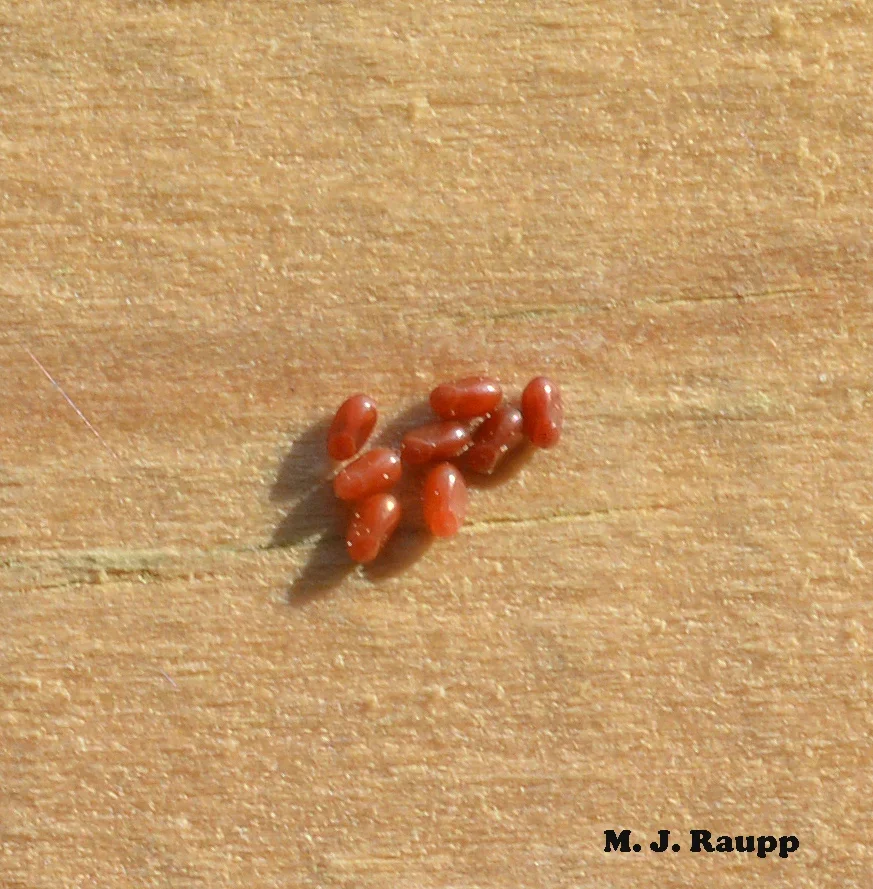
Female boxelder bugs deposit eggs in clusters. Tiny nymphs will hatch and move to the ground to consume seeds and other plant tissues.
Boxelder bugs are not harmful to humans or pets. They do not bite, sting, or reproduce indoors, however, if you squash them on your drapes or walls, they will stain. So, don’t do that. To limit the number of boxelder bugs taking up residence in your residence, eliminate overwintering places such as piles of lumber, fallen branches, or other refuges close to the house. Some folks go as far as removing boxelders, other maples, and ash trees from their landscapes to reduce food sources for nymphs and adults. Weatherproofing your home can also help keep these invaders out. Caulk and seal openings where utilities enter the home. Repair or replace door sweeps and seal any openings around windows, doors, or window air conditioners. If you find them inside your home, you might try this: simply get out the hand-held vacuum, suck them up, and release them back into the wild. It is wise to choose a liberation point some distance away from your home.
Did you always want to know what the boxelder bug’s proboscis is and what it does? Well, watch this.
Acknowledgements
We thank Anne Marie and Dennis for sharing their boxelder bugs. Jackie, who enjoyed boxelder bugs at the playground, provided the inspiration for this episode. The wonderful reference “Urban Insects and Arachnids: A Handbook of Urban Entomology” by William Robinson was used as a reference.