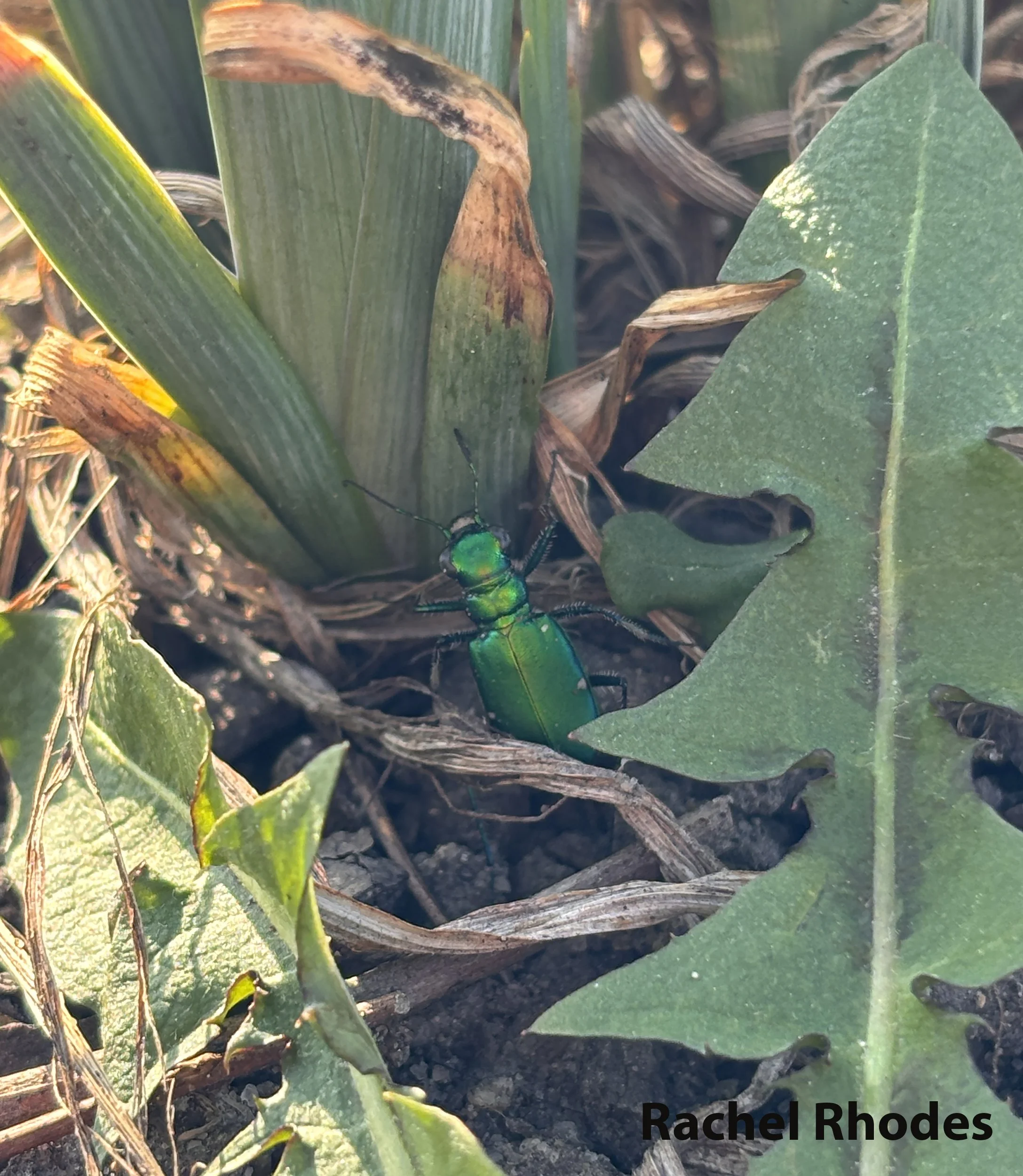
Over the past two weeks several parts of our country experienced record warmth for the month of April. Here in the DMV one of the sure signs that spring has truly arrived is the appearance of one of the most beautiful insects in Mother Nature’s panoply of six-legged wonders, gorgeous six-spotted green tiger beetles. One of our eagle-eyed extension agents in Queen Anne’s County, MD, sent me an image of a pretty tiger beetle hunkered down amongst the vegetation in her flower bed. Last week, while peddling along the C & O canal in Washington County, MD, busy green tiger beetles scattered away from my oncoming bike.
A while ago I saw this little beauty prowling around my garden. Look at the way those jaws snap open and closed. I surely wouldn’t want to be a little bug in the way of this hungry predator. To see these guys in action in the wild, I went to a sunny bike trail in western Maryland. Tiger beetles were all over the place. Watch what happens when a bicycle approaches the beetle. That’s what I call a rapid escape. Let’s slow it down by 95% and see how that tiger beetle gets out of the way. Wow, that was fast. I guess all tiger beetles aren’t so quick on their feet. Look what happened to this one that couldn’t get out of the way of a bicycle. These bicycle trails can be dangerous places for tiger beetles to hang out. Maybe we need signs to warn cyclists of tiger beetles crossing.
Six-spotted green tiger beetles range from southern Canada to Texas and are commonly observed in the eastern half of the US. Predators as both larvae and adults, the name “tiger” suits them well. They are awesome hunters. The exceptionally long legs of adults provide lots of ground clearance and enable bursts of speed as they dash across trails and forest floors. Large eyes enable them to peruse their surroundings for signs of movement and potential meals. Unlike praying mantids that are “sit and wait” predators, tiger beetles actively stalk, pursue, and capture their victims. One amusing trick to play with these hunters is to spot one at a distance and toss a pebble or a small twig near the beetle. This often triggers an inquisitive charge as the beetle scrambles to see if a potential meal has entered its ambit.
Several years ago, I invited a handsome tiger beetle called Tommy into my kitchen to have a caterpillar snack. At first, Tommy seemed startled by a tent caterpillar that ventured just a little too close. A few moments later, I discovered Tommy behaving more like his “tiger” namesake as he snacked on the rear-end of the caterpillar. Watch as his sharp paired mandibles (jaws) and the second pair of mouthparts called maxillae move back and forth to ingest his tasty treat.
Like their feline namesake, the tiger beetle has powerful jaws used to capture, subdue, and consume its victim. Each jaw is armed with several stout teeth. The jaws grasp, pierce, slice, and crush. Just behind the jaws, a second pair of mouthparts called maxillae help shove pieces of flesh into the maw of the beetle’s digestive tract. Tiger beetles are carnivores as both adults and juveniles. The female tiger beetle lays eggs singly on the ground. Upon hatching, the immature stage, the larva, constructs an underground burrow. From this lair, the larva stealthily awaits dinner. As a hapless insect or spider strolls by, the larva springs from the hole like a jack-in-the-box and impales its victim with stiletto-like jaws. The prey is drawn into the burrow and eaten. Strange hook-like structures found on its abdomen help anchor the beetle larva in its burrow.
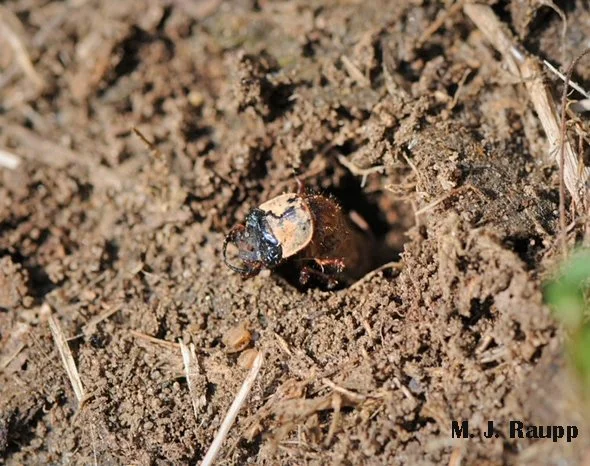
The strange tiger beetle larva lives in an underground lair and captures unsuspecting prey that stray too near.
As generalist predators and members of Mother Nature’s hit squad, tiger beetles consume pests in our gardens and landscapes and provide the important ecological service of biological control. Tiger beetles are tough to capture without a net, but if you catch one, be careful; they have powerful jaws and can give you a little nip. These diminutive tigers will be common along sunny bike trails and paths over the next few months. If you have some free time, take a walk in the forest or ride along one of the many beautiful bike paths here in the DMV to catch a glimpse of these tiny awesome predators.
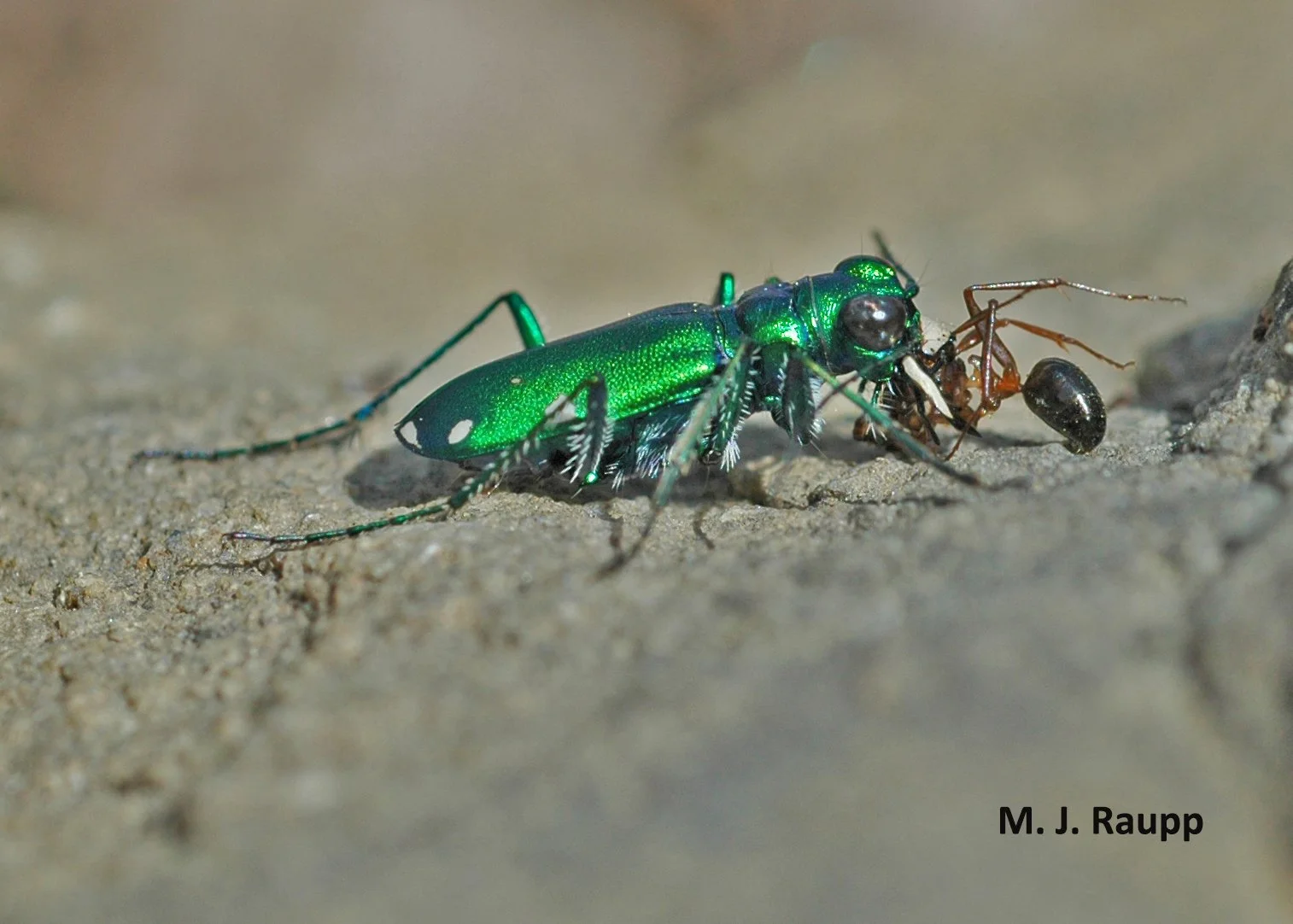
Tough luck for an ant on my garden wall.
Acknowledgements
“An Introduction to the Study of Insects” by Borrer, De Long, and Tripplehorn, and iNaturalist were used as resources for this episode. Thanks to Rachel Rhodes for sharing her image of a tiger beetle that inspired this episode.