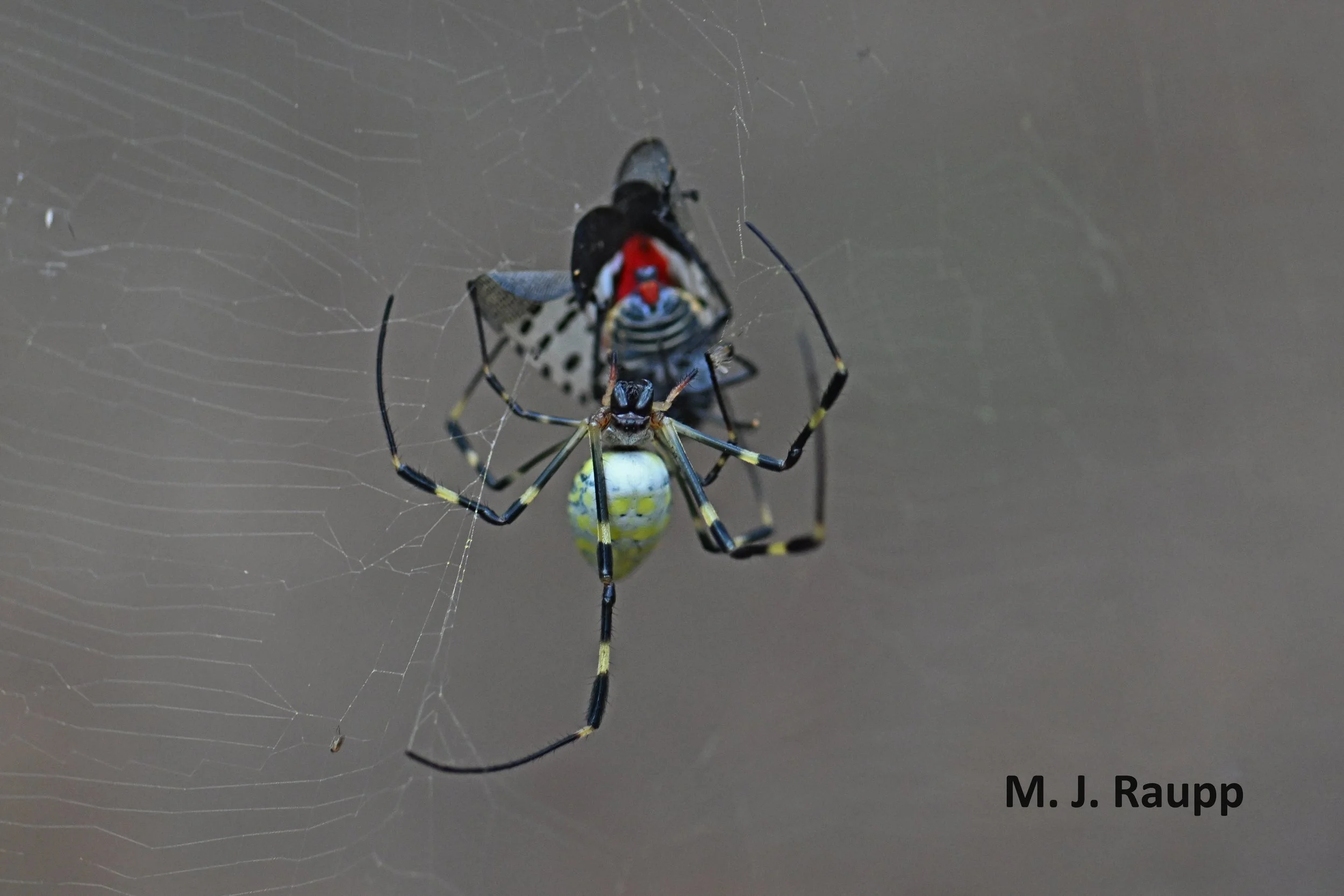
Earlier this year we caught up with the Jorō spider and learned about its ability to colonize and thrive in many different habitats including busy urban locations. At the time of this writing according to iNaturalist, Jorō now occupies locations in more than a dozen states, and here in the DMV Jorō has been sighted in several locations in Virginia and in Howard, Anne Aurndel, Prince Georges, and Baltimore Counties in Maryland. On a recent visit to what I call ‘the enchanted forest of Jorō spiders’, I was amazed to see how the density of these large spiders in a small woodlot had grown from just a few scattered webs to so many it was hard to walk in the forest without bumping into a web. Subscribers to Bug of the Week will recall that in recent weeks we learned about the fondness of several native spiders like the spotted orb weaver, black and yellow garden spider, and common house spider for dining on spotted lanternflies. Well, given the deluge of spotted lanternflies that have been plaguing the DMV recently and the successful ability of Jorō spiders to establish and thrive in the DMV, it only seemed logical to reunite these two old acquaintances from Asia to see what might happen.
After collecting a jar full of lanternflies from my back porch, I visited the forest of Jorō spiders and gently placed a lanternfly in the sticky spiral threads of the web. Unfortunately, the spider moved swiftly from the center of the web to the thrashing lanternfly before I could start my camera. However, Jorō clearly knew what to do with the lanternfly and proceeded to munch on the lanternfly’s wings with its fangs. In short suspense, the lanternfly was subdued and immobile. In a rare moment of clarity, having recently posted a story about home invasions by brown marmorated stink bugs, I wondered what might happen if this other invader from Asia, the stink bug, was reunited with its former predator, the Jorō. After procuring some stink bugs and finding another Jorō that looked hungry, I placed the stink bug in the web. As before, when entangled in the web of the Jorō, vibrations of the web by the stink bug quickly drew the spider to its hapless victim which was fanged and subdued in short order. After capturing her prey, the spider clipped some threads and retreated to the center of her web with the stink bug.
Jorō spiders build enormous webs. I visited the forest of Jorō spiders and gently placed a lanternfly in the sticky spiral threads of the web. In a flash, the spider moved from the center of the web to the thrashing lanternfly. Jorō clearly knew what to do with the lanternfly and proceeded to munch on the lanternfly’s wings with its fangs. In short suspense, the lanternfly was subdued and immobile. I wondered what might happen if the brown marmorated stink bug was reunited with Jorō. I placed a stink bug in the web. Once entangled, vibrations of the web by the stink bug quickly drew the spider to its victim. The spider fanged and subdued the stink bug in short order and retreated to the center of her web with her meal. Final score: Jorō 2, invasive pests from Asia 0.
As noted by many scientists, beyond being large and maybe a bit scary, Jorō spiders are unlikely to pose any health threat to people or pets. According to expert Rick Hoebeke, the risks to humans and pets are small due to the puny size of Jorō’s fangs, which are unlikely to pierce our skin. Jorō spider expert Andrew Davis provided these calming words in a recent interview "This spider is not going to harm people, and it’s only going to hurt you if you try to pick it up." The major remaining concern is how Jorō will impact our current ecosystems. As with all non-native species that arrive in our land, it is difficult to predict what impact they will have on our ecosystems, but experts suggest that beyond their somewhat scary mien they may give our indigenous large orb weavers like the black and yellow garden spider, marbled orb weaver, and spotted orb weaver a run for their money. In locations in other parts of the country where Jorō is established, it often becomes the most abundant and dominant orb weaver. However, rapidly expanding Jorō spiders are on a collision course with two major crop pests, spotted lanternfly and brown marmorated stink bugs. As we have seen here, Jorō certainly knows what to do with these non-native pests. What will Jorō mean for our native spiders and several of our non-native pests with which it shares a historical link at the dinner table? Only time will tell.
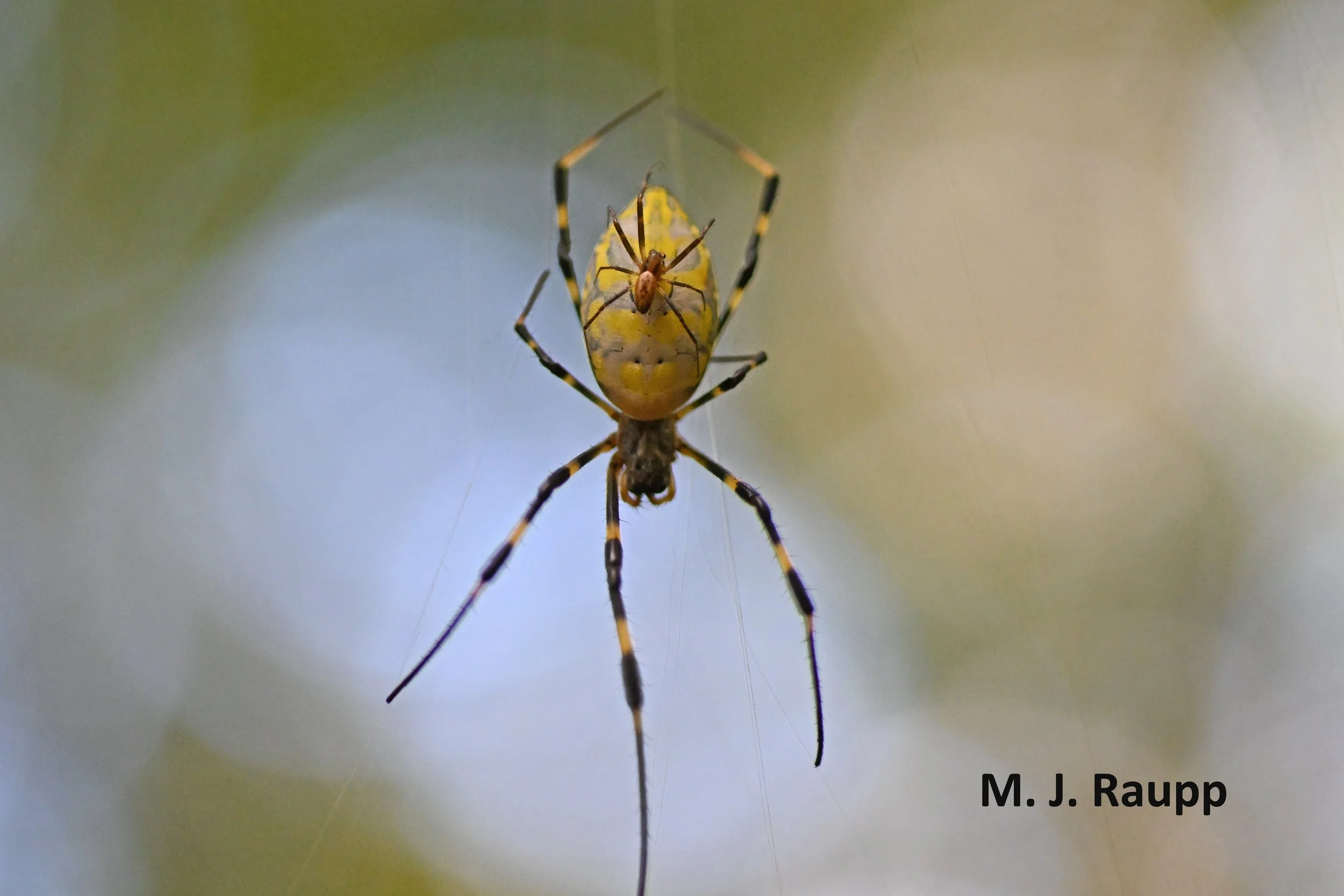
In the world of spiders, males are often much smaller than their mates. See the tiny male Jorō riding on the back of his enormous mate.
Acknowledgements
Bug of the Week thanks Rick Hoebeke for identifying Jorō as it arrived in the US and for providing insights into the ways of these large, beautiful spiders. Fascinating studies entitled “Veni, vidi, vici? Future spread and ecological impacts of a rapidly expanding invasive predator population” by David R. Nelsen, Aaron G. Corbit, Angela Chuang, John F. Deitsch, Michael I. Sitvarin and David R. Coyle, “Physiological evaluation of newly invasive Jorō spiders (Trichonephila clavata) in the southeastern USA compared to their naturalized cousin, Trichonephila clavipes” by Andrew K. Davis and Benjamin L. Frick, “Nephila clavata L Koch, the Jorō Spider of East Asia, newly recorded from North America (Araneae: Nephilidae)” by E. Richard Hoebeke, Wesley Huffmaster, and Byron J Freeman, “The Life Cycle, Habitat and Variation in Selected Web Parameters in the Spider, Nephila clavipes Koch (Araneidae)” by Clovis W. Moore, “Startle responses of jorō spiders (Trichonephila clavata) to artificial disturbance’ by Andrew K. Davis and A. Anerao, and “How Urban-Tolerant Are They? Testing Prey–Capture Behavior of Introduced Jorō Spiders (Trichonephila clavata) Next to Busy Roads” by Andrew K. Davis, Kade Stewart, Caitlin Phelan and Alexa Schultz, were used in writing this episode. Inspiration for this episode came from Director Ron Harris (with Westside Films) and Executive Producer Zoë Barracano.
To see other large orb weavers and differentiate them from the Jorō spider, please click on this link: https://resources.ipmcenters.org/view/resource.cfm?rid=27877
To hear more about the Jorō spider and calm your fears about it, please click on this link to watch Jorō guru David Coyle’s take on this spider: https://youtu.be/zhO_bwwg-E4?si=nhd9au-t-HRCmw6b