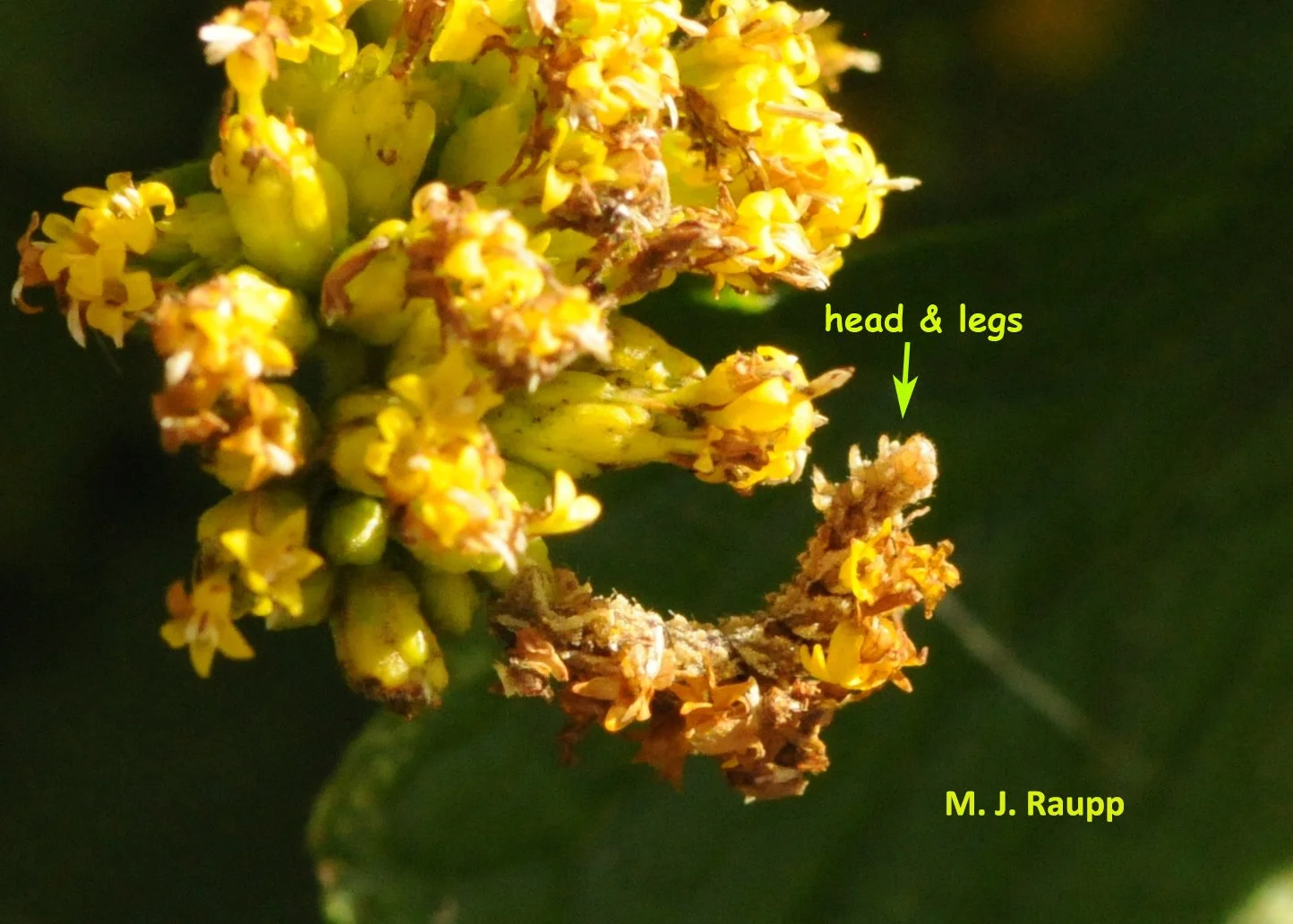
Movie aficionados may have seen Mark Wahlberg in “Shooter”, a warrior who dons a “ghillie suit.” The ghillie suit incorporates leaves and branches into a camouflaged garment to hide a person from an enemy. Next time you see something like this, just remember that several million years ago a caterpillar thought of it first. Here’s the backstory. One morning last week as I enjoyed the pollinators in my front flower bed while sipping my morning joe, I noticed a cluster of withered flower petals swaying on a spent flowerhead of a wild bergamot. While this would have meant nothing on a breezy day, it was a puzzle on that still morning.
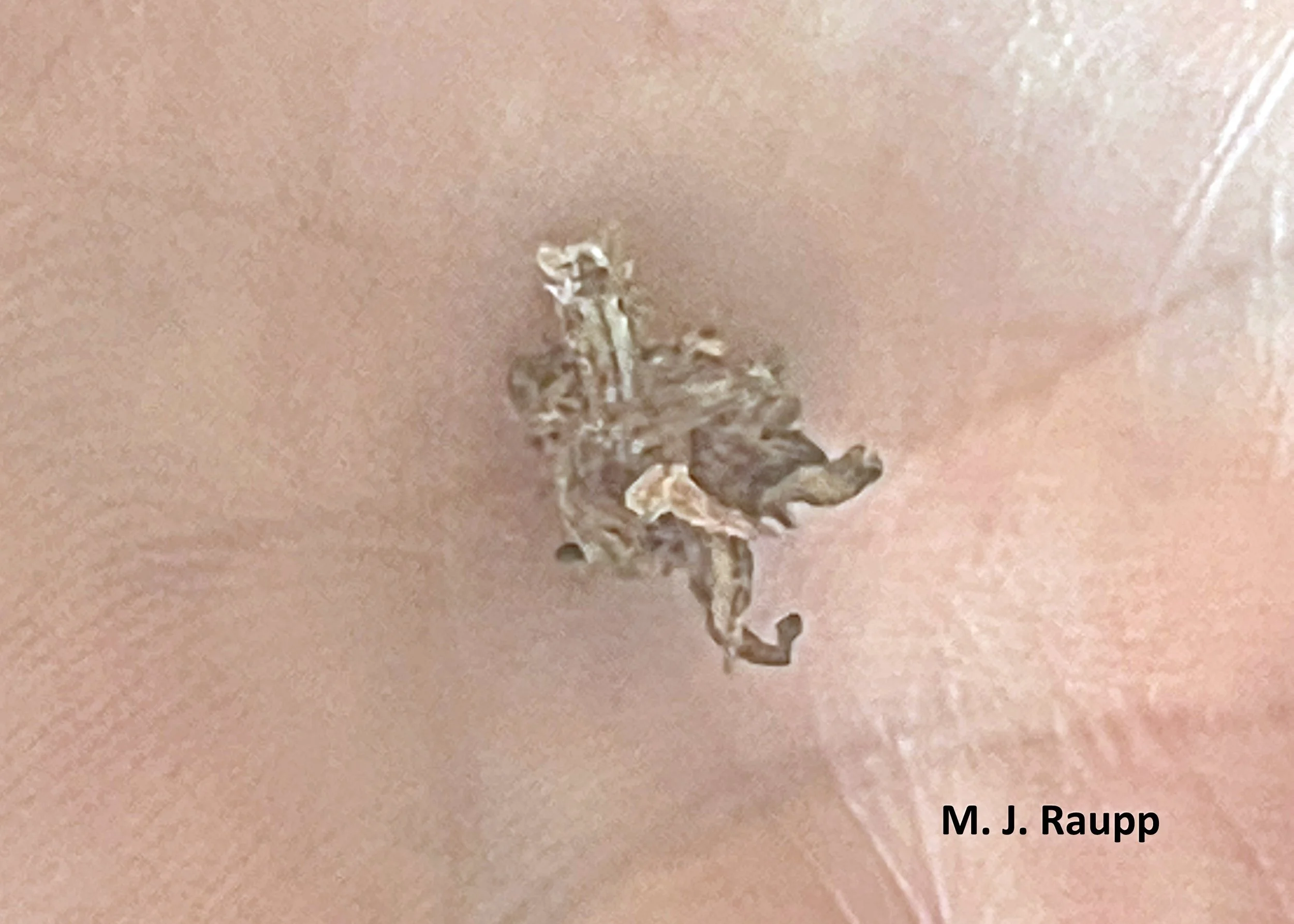
A ghillie suit of withered burgamot flower petals hides a camouflaged looper within.
A closer inspection revealed that beneath the vegetation, a surprisingly handsome caterpillar wearing a ghillie suit was responsible for animating the withered blossoms. This little trickster was the camouflaged looper, Synchlora aerata. Bedecked with bits of foliage and flower petals, it is sometimes detected when performing a herky-jerky waltz as it moves from one meal to the next. If you have the good fortune to find one, take a moment to sit and watch a stellar performance as the looper sways back and forth, adding to the illusion of a plant part being blown by the wind.
Last week while sipping my morning coffee, I noticed some withered vegetation swaying on a spent flowerhead of wild bergamot on a windless day. When transferred to the siding of the house, this faded foliage revealed itself as camouflaged looper caterpillar. Its superpower lies in its ability to disguise itself using leaves and petals of the flowers on which it feeds. When dining on fading bergamot, browns and grays seem the smart camouflage choice. But when crimson mums are on the menu, it’s better to go with the crimson petals. And when you depart for the next meal add a little “I’m just a petal swaying in the breeze” to your routine just to fool the hungry eyes of predators. Adults of these tricksters are the lovely geometrid moth called the wavy-lined emerald. As autumn approaches, have fun searching for these cool caterpillars in the flower garden or meadow.
Loopers are members of a large family of moths known as geometrids. The name geometrid stems from Greek roots meaning ‘earth measure’. Another common name for some geometrid caterpillars is inchworms. As they cruise about the blossoms, loopers and inchworms do appear to measure the earth inch by inch. In addition to my chrysanthemums, camouflaged loopers eat many types of flowers including ageratum, aster, black-eyed Susan, boneset, coreopsis, daisy, goldenrod, Joe Pye weed, ragweed, raspberry, rose, sage, St. John’s wort, and yarrow. The adult stage of the camouflaged looper is a moth known as the wavy-lined emerald and it is every bit as beautiful as the larva.
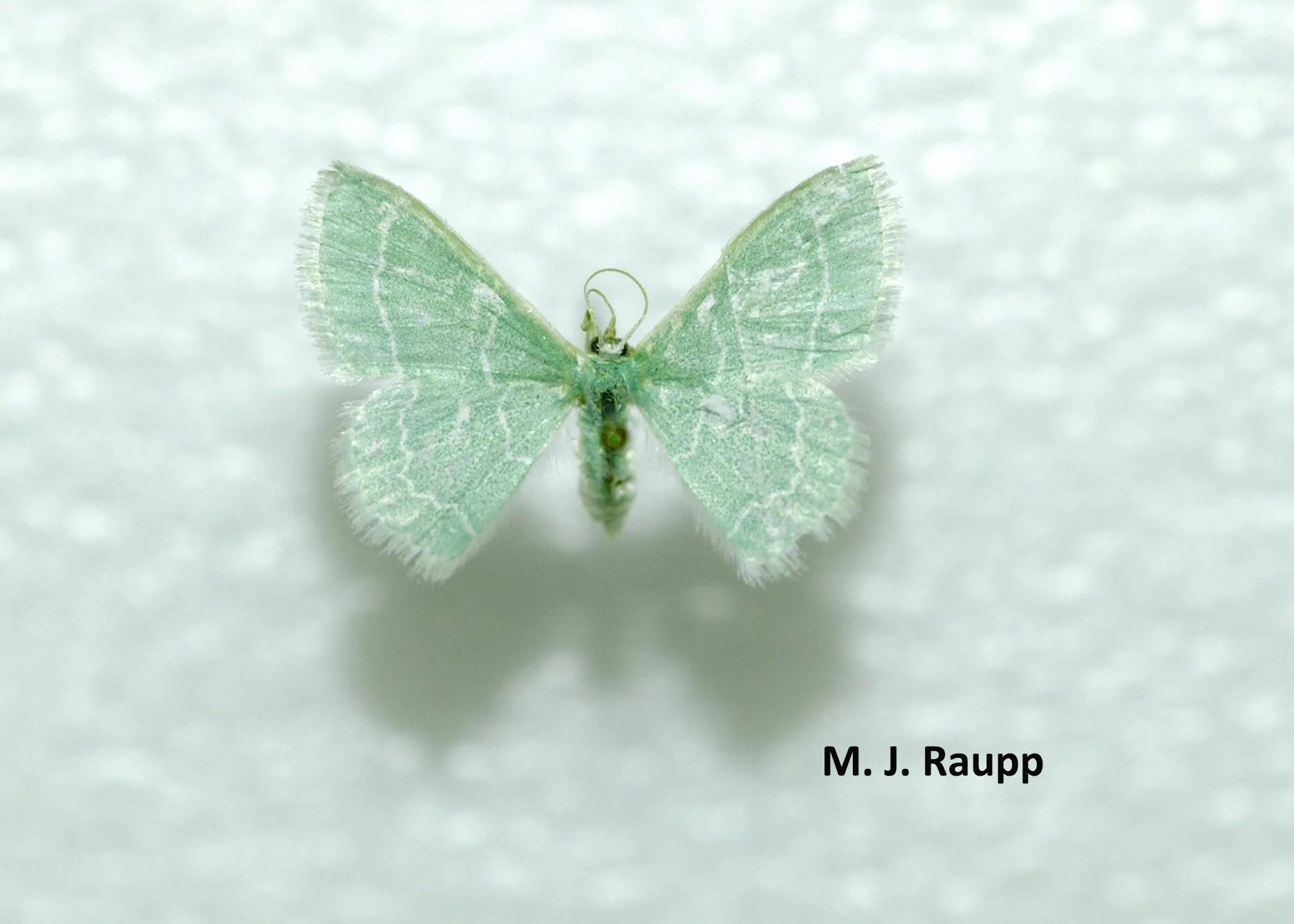
The camouflaged looper turns into a pretty, wavy-lined emerald moth.
A few years back, while working pulling weeds in a bed of chrysanthemums, I noticed a liberal sprinkling of caterpillar frass decorating blossoms of several plants. Frass, the euphemistic term for the pellet-like, powdery, or sawdust-like excrement of herbivorous insects, often provides a clue, alerting one to the presence of an insect on or in a plant. A thorough inspection of my mums failed to disclose the culprit, but as I watched the plant over a leisurely cup of coffee, I noticed a small cluster of flowery debris swaying on a blossom. A closer inspection revealed a cleverly disguised camouflaged looper cloaked in purple petals busily dining on the flower head. In years past, several eagle-eyed naturalists reported similar sightings on mints and Joe Pye weeds in gardens and meadows as summer turns into autumn. So next time you see some unexpected frass on your flower blossoms or a small cluster of vegetation swaying in the wind, take a few moments to observe your flowers with an eye out for these masters of disguise.
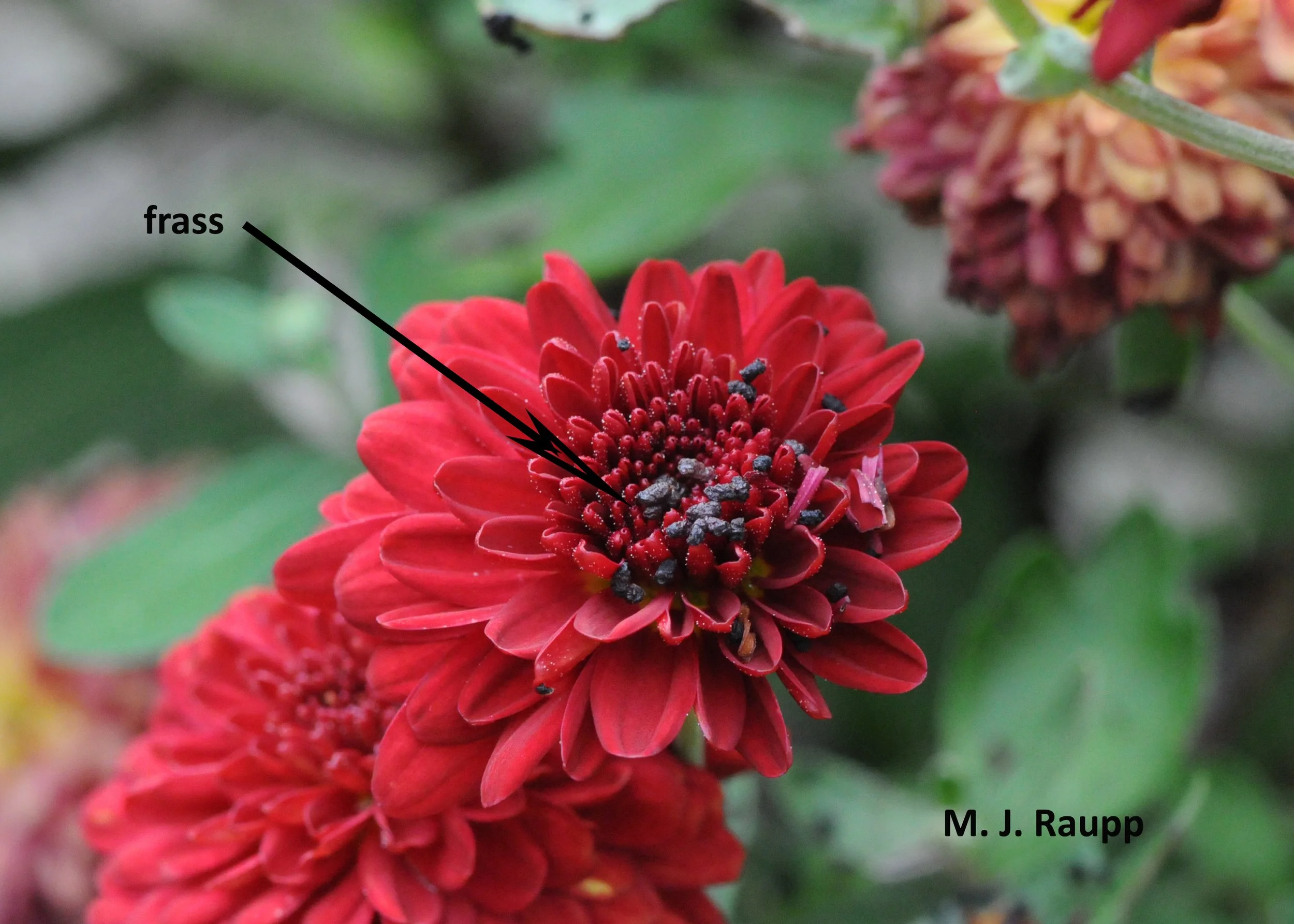
A blossom full of frass is a pretty good clue that a caterpillar may be lurking nearby. This frass was produced by a camouflaged looper feeding nearby.
Acknowledgements
Many thanks to our observant naturalists who discovered camouflaged loopers in their landscape, especially Mara McCall and Glen Schulze, for providing the inspiration for this episode. The wonderful reference “Caterpillars of Eastern North America” by David Wagner was used as a reference for this Bug of the Week.