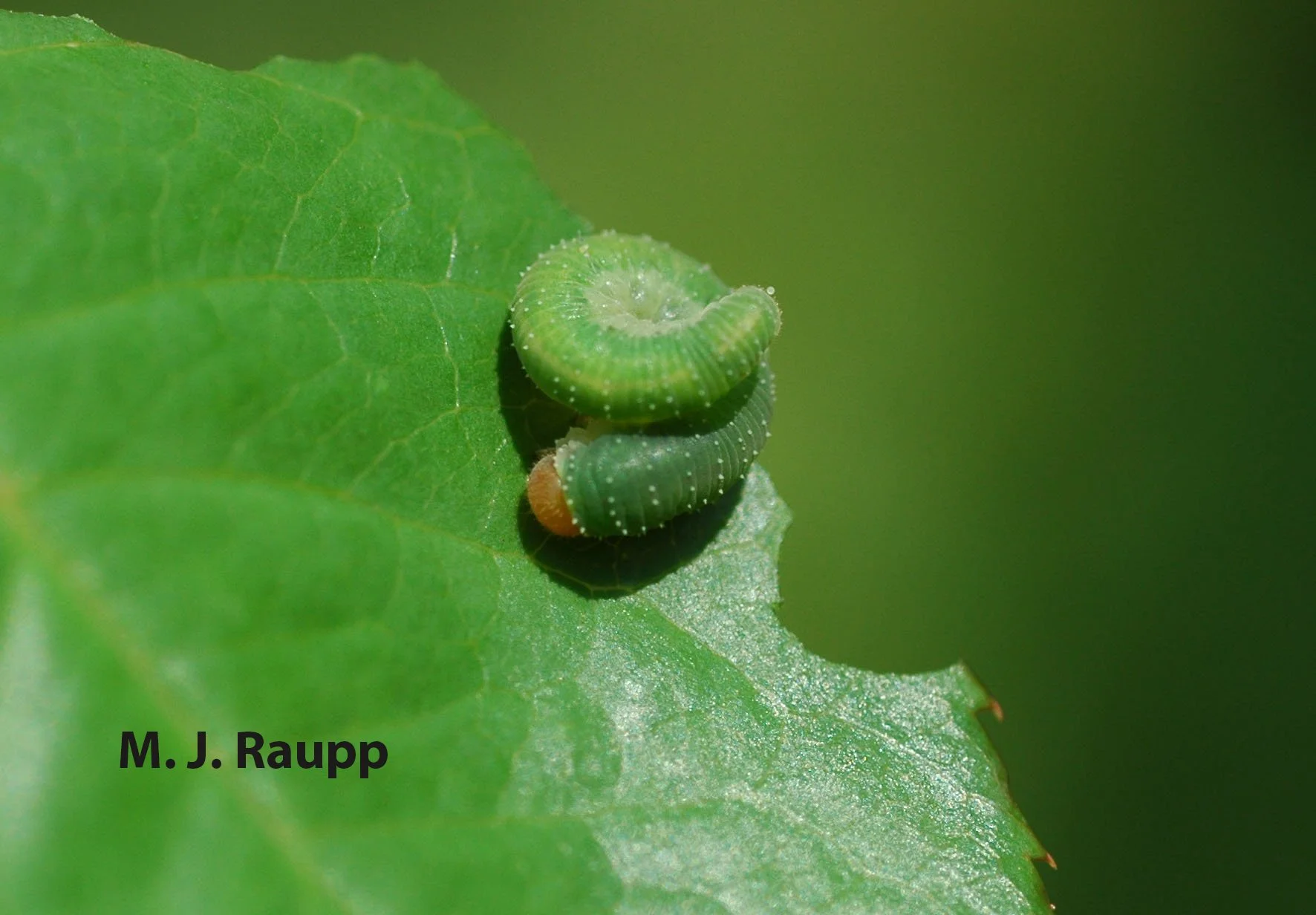
On a recent visit to one of my favorite relatives, while enjoying the fragrances and beauty of roses in their garden, I noticed some unnerving injury to the foliage of several plants. The injury took the form of a type of herbivore mischief known as etching. Etching results when small insects use their jaws to remove soft tissues between the vascular bundles that crisscross leaves, leaving behind veins and a layer of epidermal tissue. This produces a windowpane, or skeletonized, effect, and these withered leaves often appear like someone took a blowtorch to them. A wide variety of beetles and caterpillars are the usual suspects when skeletonization is afoot. However, in this bed of roses, sawflies larvae were the culprits.
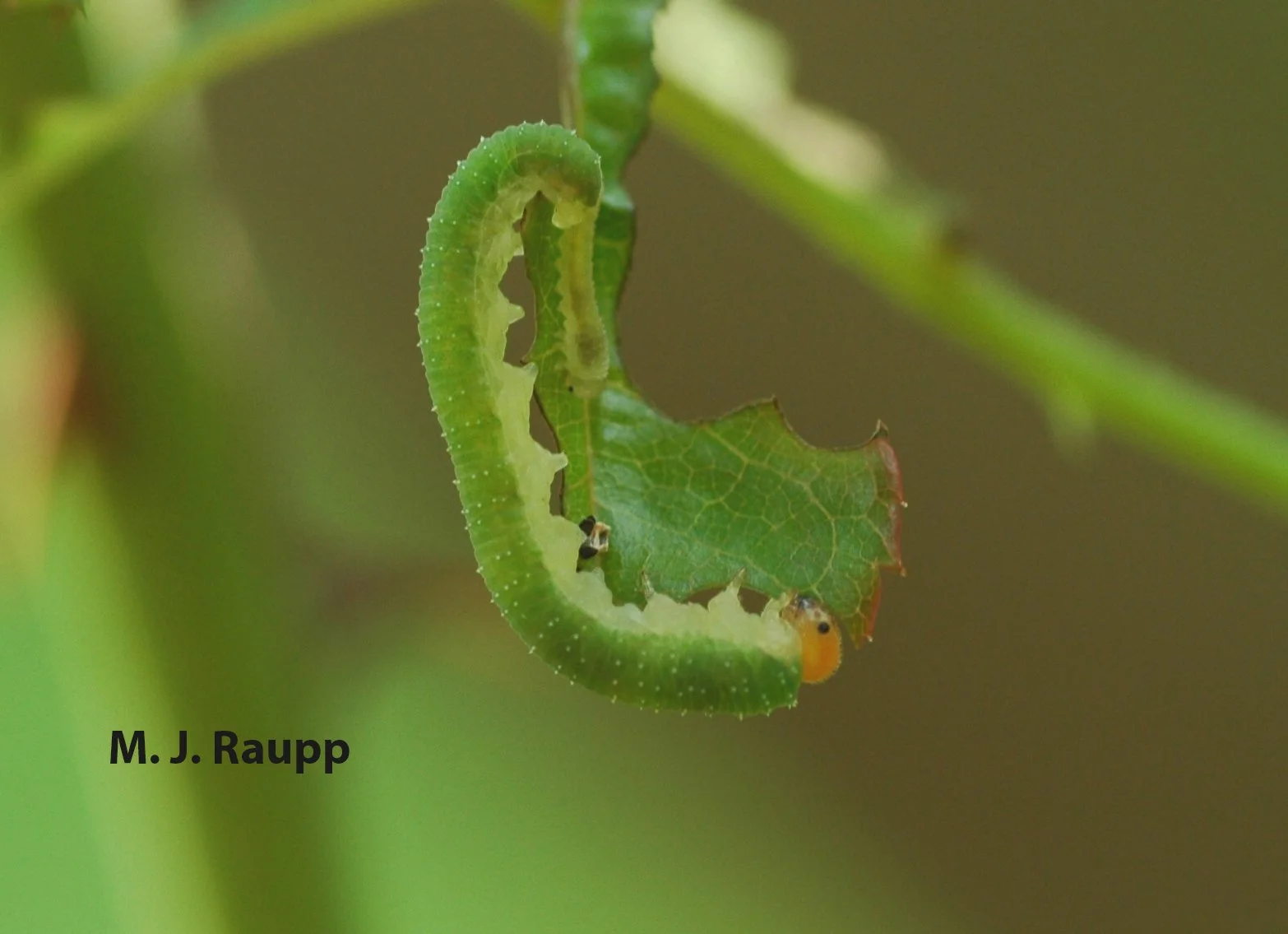
Not much left after the curled rose sawfly finishes a leaf. Can you see a second sawfly larva in this picture?
Sawflies are unusual insects, an ancient branch of the bee and wasp clan. Unlike the larvae of bees and wasps that make their living consuming nectar and pollen or the flesh and blood of insects, the larvae of most sawflies are plant feeders. At first glance, sawfly larvae look like small caterpillars with slender bodies and distinct heads. Upon microscopic inspection, you can see that the posterior segments of the sawfly’s body bear small sucker-like appendages called prolegs. Prolegs adorn the abdominal segments of plant-eating moth and butterfly larvae as well. But moth and butterfly caterpillars never bear more than five pairs of prolegs. Most sawfly larvae have six or more pairs. Another difference between these look-alikes is the presence or absence of small fishhook-like structures called crochets on the prolegs. Caterpillars have them, sawfly larvae do not. Crochets help caterpillars hold onto the smooth surface of a plant leaf.
Dappled in sunshine, a pair of roseslug sawfly larvae strip nutritious tissue from a leaf blade, leaving only veins and a thin layer of epidermis behind. Through the lens of the microscope, you can get up close and personal with a bristly roselug as it gobbles leaf tissue. As leaves desiccate later in summer, they crinkle and turn brown as if toasted by a blowtorch.
After spending the winter as juveniles in the soil beneath rose plants, in spring when foliage returns the roseslug sawfly completes its development, and small wasp-like adults fly to leaves where they deposit eggs with an egg-laying appendage called an ovipositor. The ovipositor has teeth like a saw’s blade, hence the name sawfly. Eggs hatch and the larvae proceed to pillage rose leaves through May and June. Fortunately, only one generation of these scalawags occurs each year, but in some years, they may be abundant enough that by the end of June they can make roses look like they have been assaulted by a flame thrower.
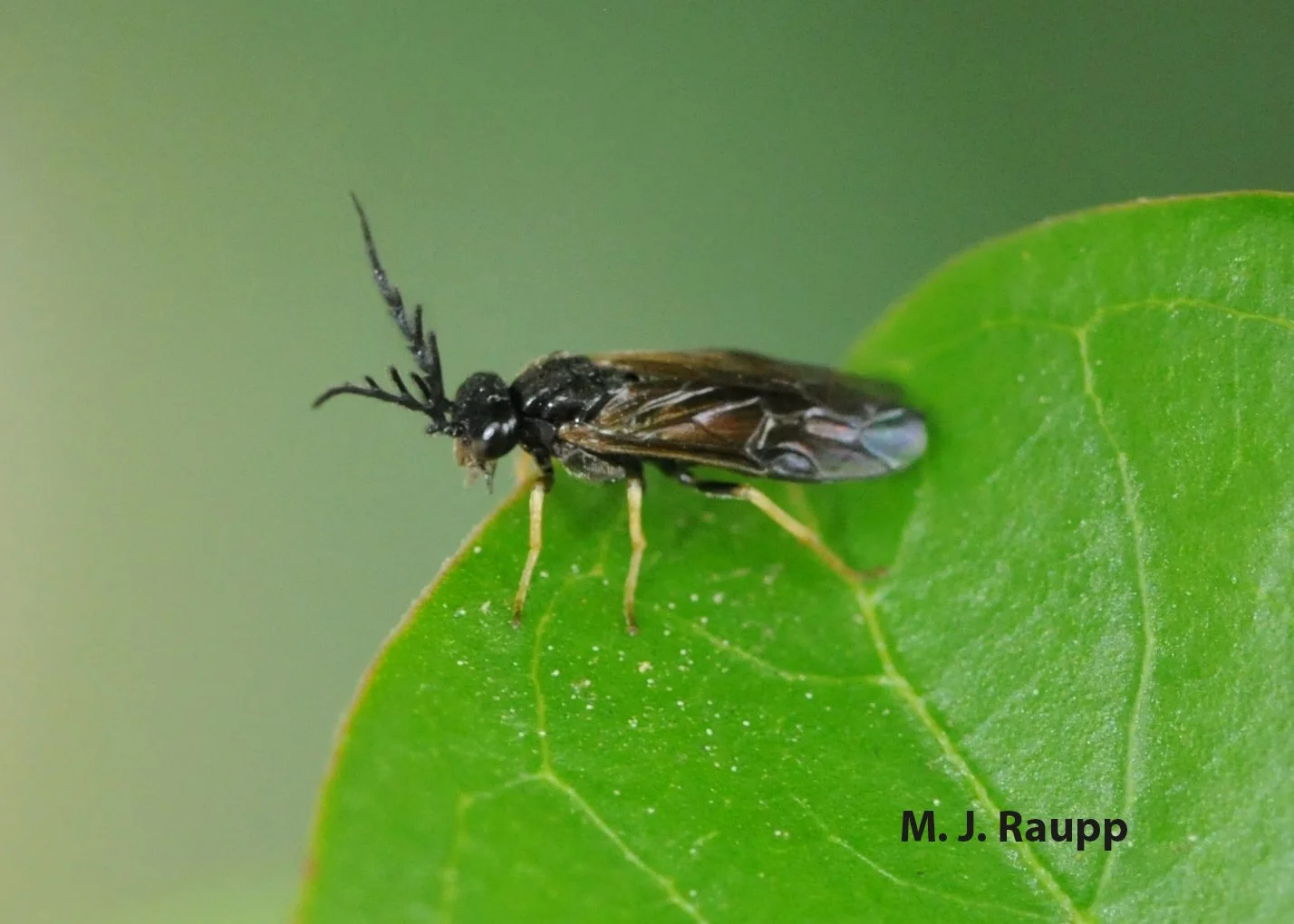
Impressive antennae adorn this tiny adult sawfly.
In addition to skeletonization, several leaves had large chunks of leaf tissue missing from the edges of the blade. This defoliation was the handiwork of the curled rose sawfly, an insidious leaf-munching machine that is beautifully camouflaged. When not actively feeding along the margin of a rose leaf, it is curled on the underside of a leaf or on a bud where it blends in cryptically with plant. After several days of hide-and-go-eat, the entire leaf may be reduced to nothing but a mid-vein. When its development is complete, the larva bores into the twig, where it pupates. Later a small wasp will emerge, mate, lay eggs and initiate a second seasonal generation.
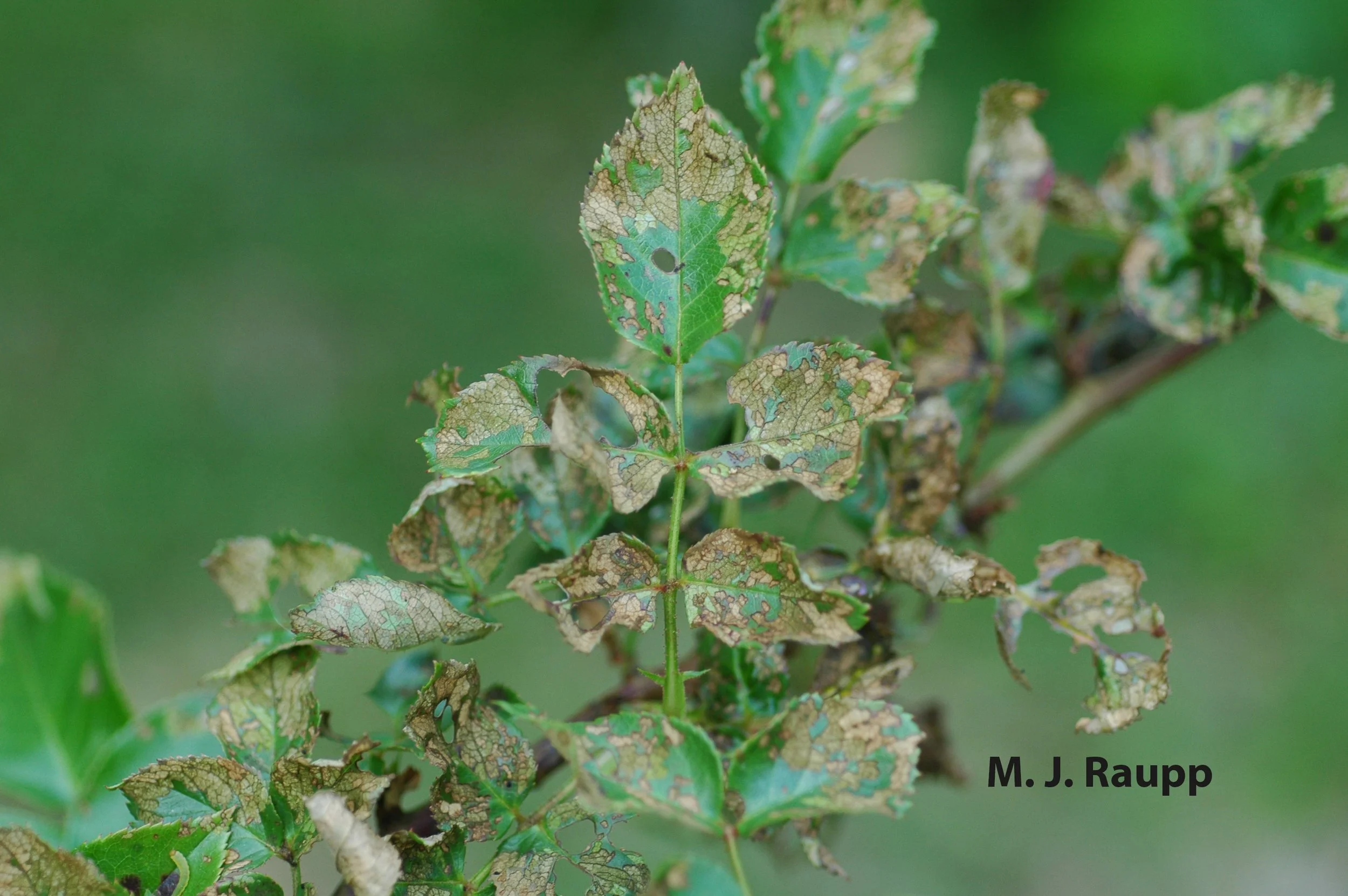
By mid-summer roses damaged by sawfly larvae look like they were toasted with a blowtorch.
In May and June, I regularly inspect my roses for the telltale signs of skeletonization and defoliation. If sawflies are common enough to create problems for my roses, I simply squish the little buggers between my fingers or pluck them off and toss them in the lawn to become a feast for the ground beetles or lightning bug larvae lurking in the thatch. Several environmentally friendly insecticides listed by the Organic Materials Review Institute (OMRI) with active ingredients including insecticidal soap and spinosad work well against these sawflies. OMRI listed products are used for production of fruits and vegetables marketed as organic, and when insecticide applications are necessary, I try to select from the OMRI list whenever possible. As with all insecticides, always read the label carefully and follow precautions, including those safeguarding bees and other pollinators that might be on your roses. Strong directed streams of water are also reported to dislodge sawfly larvae from plants. If you have roses, be on the lookout for these rose-eating rascals.
References
We thank Carole for providing the roses and sawflies that served as the inspiration for this episode. Two marvelous references, “Insects that feed on trees and shrubs” by W. T. Johnson and H. H. Lyon, and “Managing insects and mites on woody plants: An IPM approach” by J.A. Davidson and M. J. Raupp were consulted to prepare this episode.