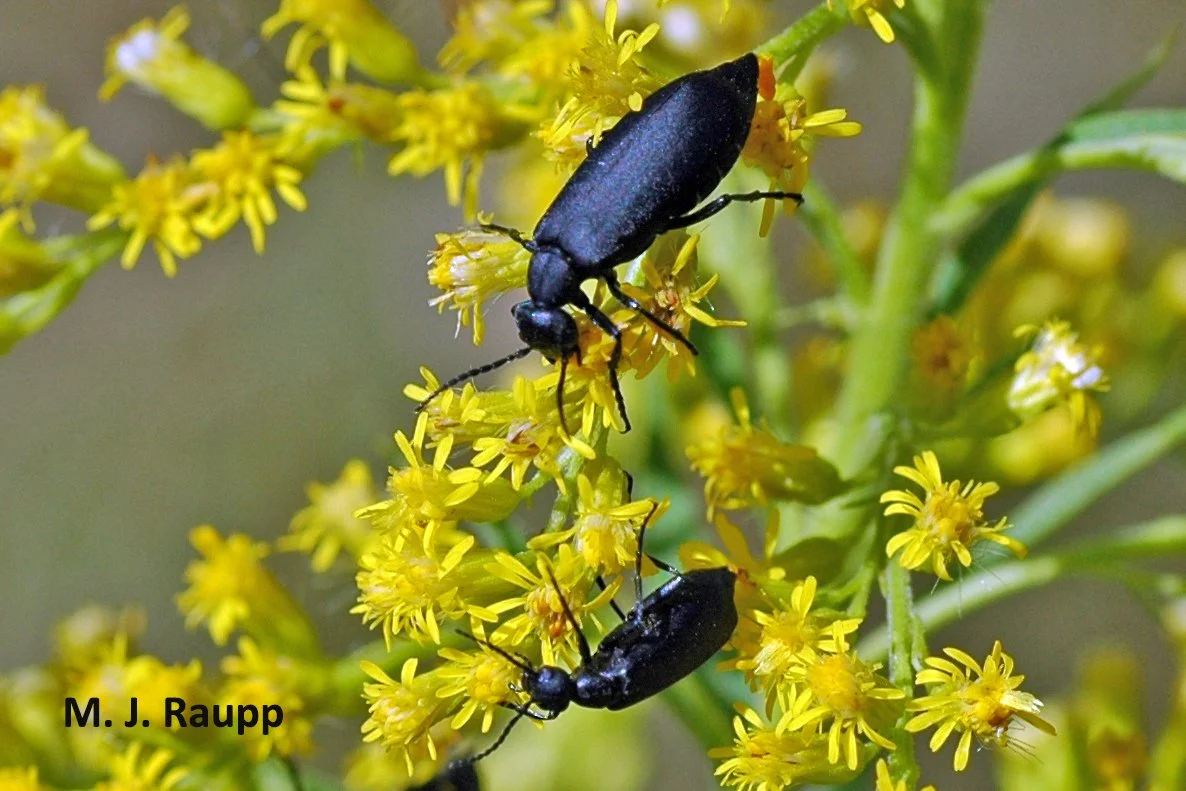
A few weeks ago, as meadows in the DMV finished their spectacular floral displays, members of the aster family put on their finest performances. Goldenrod is one of the richest late-season sources of nectar and pollen for dozens of insects. A walk on the wild side revealed bevies of black blister beetles, Epicauta pensylvanica, cavorting on brilliant goldenrod amongst the bees and flies. These lovely beetles are not to be taken lightly. If handled roughly, crushed against your skin, or worse yet consumed, blister beetles release blood laced with potent irritants called cantharidin. Cantharidin, a ten carbon, three ringed compound, is classified as extremely hazardous. Upon contacting skin, cantharidin can raise nasty looking blisters.
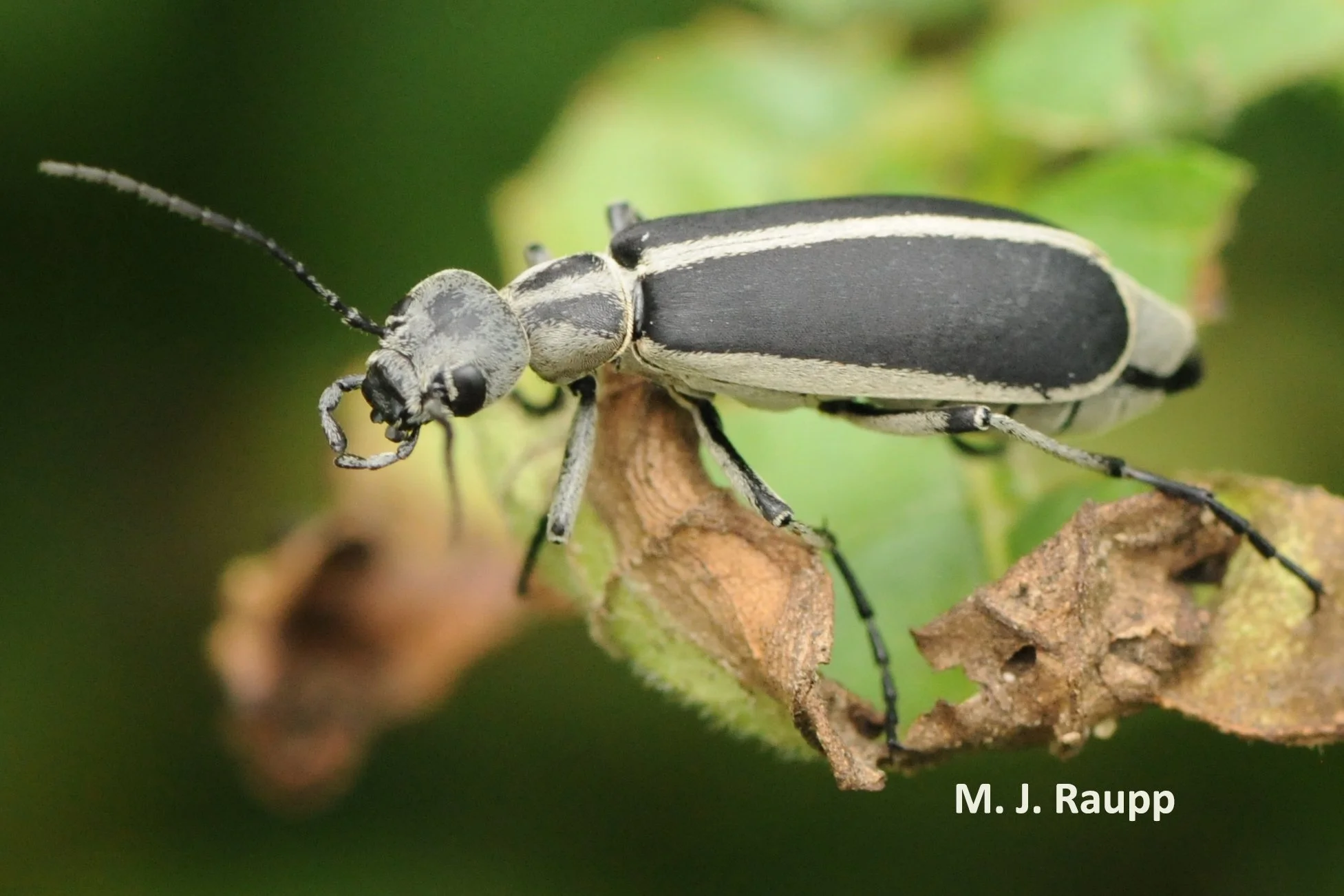
Margined blister beetles, like their cousins black blister beetles, contain noxious cantharidin and should not be handled and certainly not eaten.
Blister beetles are also the source of the medicinal compound called Spanish fly. The term Spanish fly refers to a particularly beautiful European species of blister beetle, Lytta vesicatoria, from which cantharidin is extracted. Much lore surrounds cantharidin as potions of love, healing, and death. Spanish fly was used as a medicinal in America’s revolutionary era. The father of our nation, George Washington, had a most disagreeable encounter with the Spanish fly. After taking ill, President Washington was near death on December 14, 1799. As was common medical practice at the time, Spanish fly was applied to his neck to draw out inflammation. The Spanish fly therapy and four bloodlettings on the same day proved a bit too much for our ailing founding father and he expired.
Love potions concocted with Spanish fly are said to be potent aphrodisiacs. One remarkable tale I stumbled across described a gathering hosted by the infamous Marquis de Sade. To liven things up a bit, the Marquis slipped the guests a little Spanish fly on some sweets. Unfortunately, he miscalculated the effective dose and rather than arousing his guests, several were poisoned and became violently ill.
Potato leaves provide a tasty meal for a female margined blister beetle and apparently inspire amorous behavior in a male. After being rebuffed several times by kicks of the female’s leg, perhaps persistence and a few gentle nibbles behind her head will pay off for this hopeful suitor. On the flowerhead of a late blooming wingstem, a margined blister beetle munches fruiting structures of the blossom. But please, don’t handle or eat these beautiful blister beetles.
As seen here, blister beetles forage on plants in meadows and gardens and they have been inadvertently baled in hay and fed to horses and other farm animals. Horses are especially sensitive to cantharidin and consuming beetles can be lethal. As we learned a few weeks ago, wonderful wingstem, Verbesina alternifolia, is a dynamite attractor not only for moths and butterflies, but also for blister beetles including the margined blister beetle, Epicauta funebris. In addition to posing threats to humans and livestock, blister beetles are sometimes important pests of eggplants, potatoes, tomatoes, and beets. If you see blister beetles on plants near your home or in the meadow in the waning days of autumn, resist the urge to handle or eat them unless you desire a blistering experience.
Acknowledgements
Bug of the Week gives a shout out to the Robinson Nature Center for growing goldenrods that provided inspiration for this episode. Interesting insights were provided in “Blister Beetle Management in Alfalfa” by Kevin Rice and “For the love of insects” by Thomas Eisner.