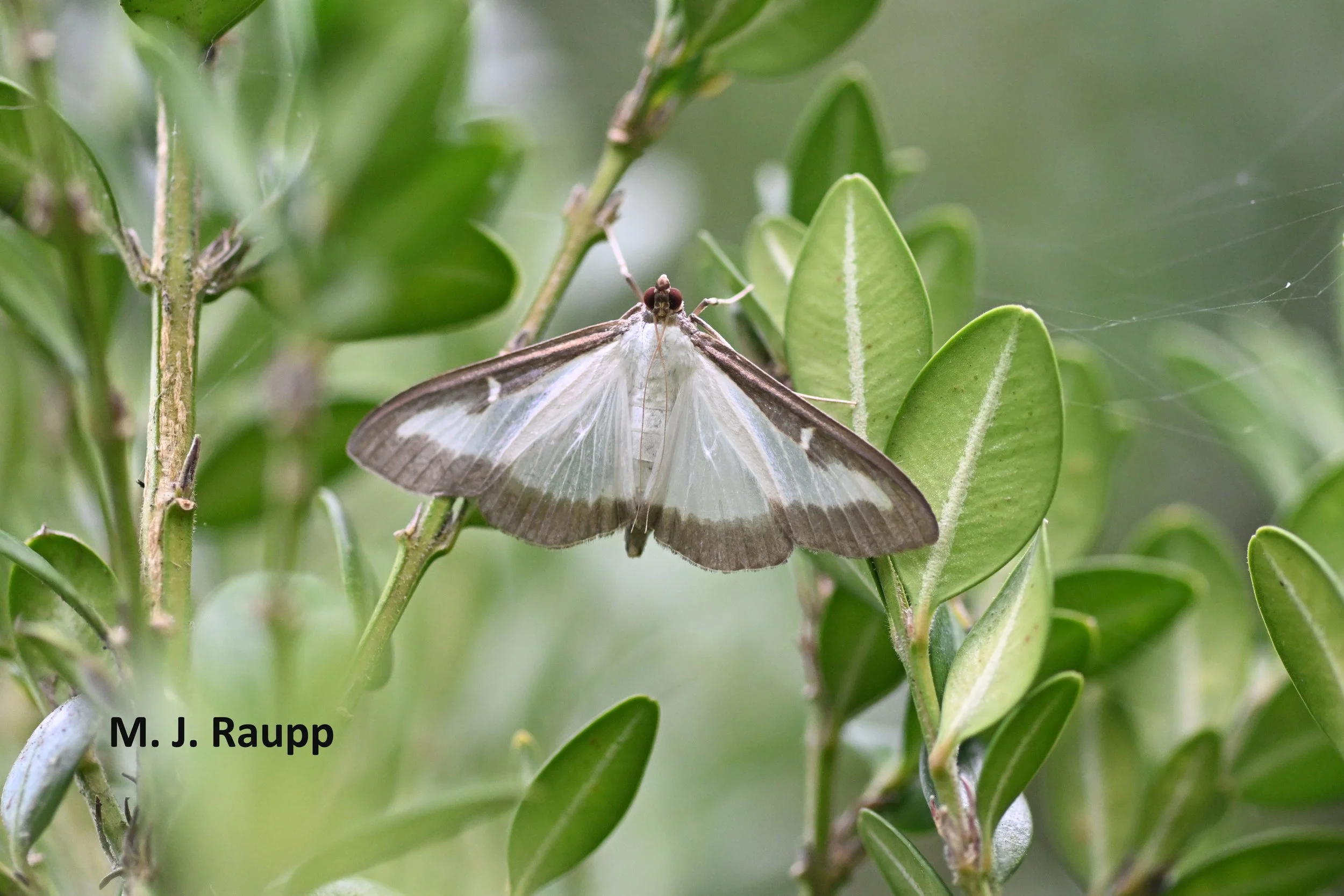
In August last year, we reported the discovery of a new invasive pest called the box tree moth (BTM) in Fort Frederick, Maryland, just across the Potomac River from West Virginia. From this first detection in Washington County last year, BTM has now been found in six counties: Washington, Caroline, Cecil, Kent, and Queen Anne's Counties. In addition to these six counties, three additional counties, Frederick, Garrett, and Allegany have been placed under quarantine orders by the State of Maryland. This pattern is mirrored by the rapid spread of BTM in the Eastern United States. The first US detection of box tree moth was in New York in 2021, and it has now spread to Delaware, Kentucky, Maryland, Massachusetts, Michigan, Ohio, Pennsylvania, Virginia, West Virginia, and New Jersey.
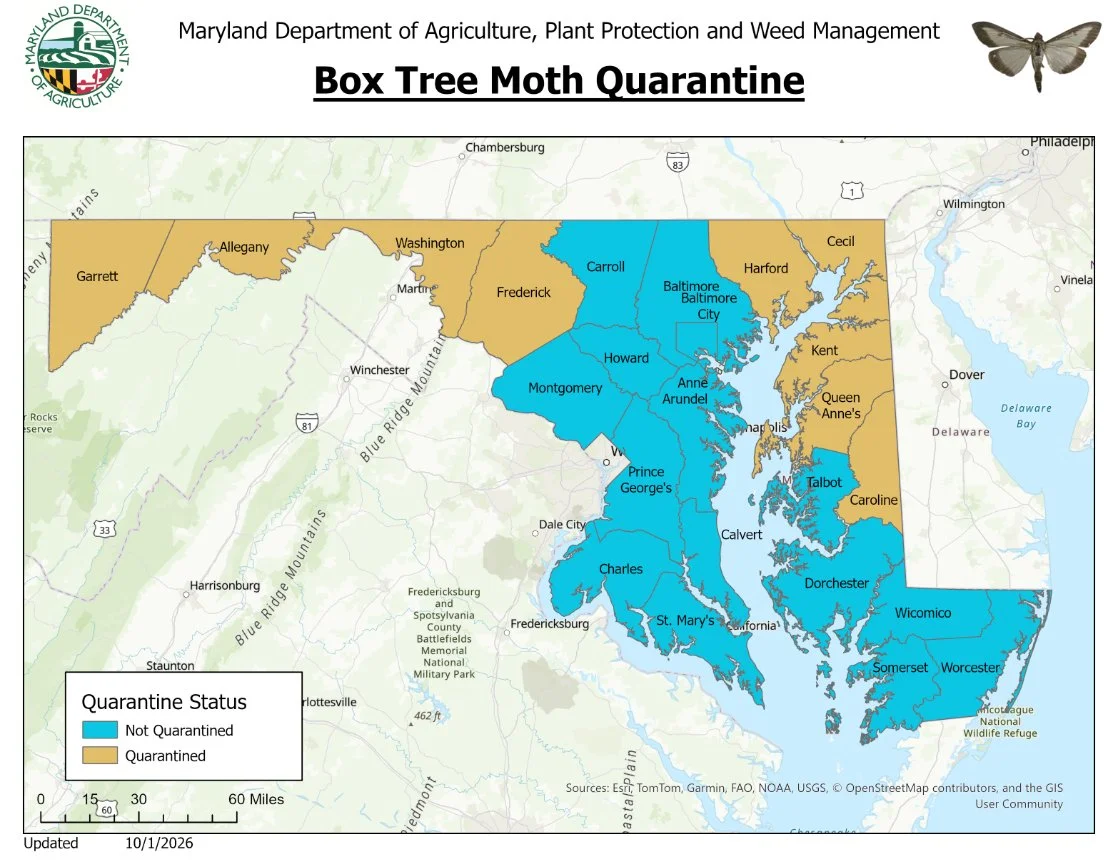
Counties in Maryland under quarantine for box tree moth. Retrieved from Maryland Department of Agriculture September 25, 2026.
Let’s revisit the episode from August 2025 to learn more about this killer of boxwoods.
“From the time of our earliest European colonists, boxwoods have been important components of ornamental landscapes. Boxwoods grace iconic landscapes in the DMV including George Washington’s home at Mount Vernon, the “Box Walk” at Dumbarton Oaks, the National Boxwood Collection at the United States National Arboretum, as well as hundreds of public and private gardens and landscapes in our region. However, boxwoods are one of the most problem-prone plants in our landscapes. Already beset by exotic pests including leafminers, spider mites, and pathogens such as boxwood blight, boxwoods in the DMV and throughout our country now face a new, lethal non-native invader, the box tree moth. Like many of our new invaders, box tree moth is native to Asia and is found in China, Japan, and Korea. Probably due to the movement of ornamental plants, it entered Europe and was first discovered in Germany in 2007. It now occupies more than 30 Eurasian countries. It jumped across the Atlantic to Canada, where it was detected in 2018, and arrived in the United States with shipments of nursery plants from Canada in 2020 and 2021. Prior to July 2025 it spread to Delaware, Massachusetts, Michigan, Ohio, Pennsylvania, West Virginia, and New York. Yes, the DMV was surrounded and sure enough, it was detected in Clarke and Loudoun Counties in Virginia and three locations in Washington County in Maryland during the latter half of July and early August.
On a recent visit to an antebellum mansion, ancient boxwoods were under attack by box tree moths. Adult moths like this one had recently emerged from ghostlike pupae hidden in the foliage. During summer and early autumn adults lay several batches of translucent eggs in ranks of 5 to 20. Eggs hatch and tiny caterpillars remove patches of tissue from the surface of leaves. Caterpillars that are not yet fully developed will form refuges called hibernacula, in which they survive the winter. In spring, caterpillars resume their carnage defoliating leaves, webbing leaves together, and littering foliage with excrement called frass. Left untreated they can destroy large hedges in a matter of months. Video by M. J. Raupp and Laura Nixon
What’s the worry? If undetected, an infested boxwood can support a rapidly expanding population of leaf-eating caterpillars capable of completely defoliating large boxwoods. In addition, they create large silken webs littered with frass that accumulates on plants and surfaces below.
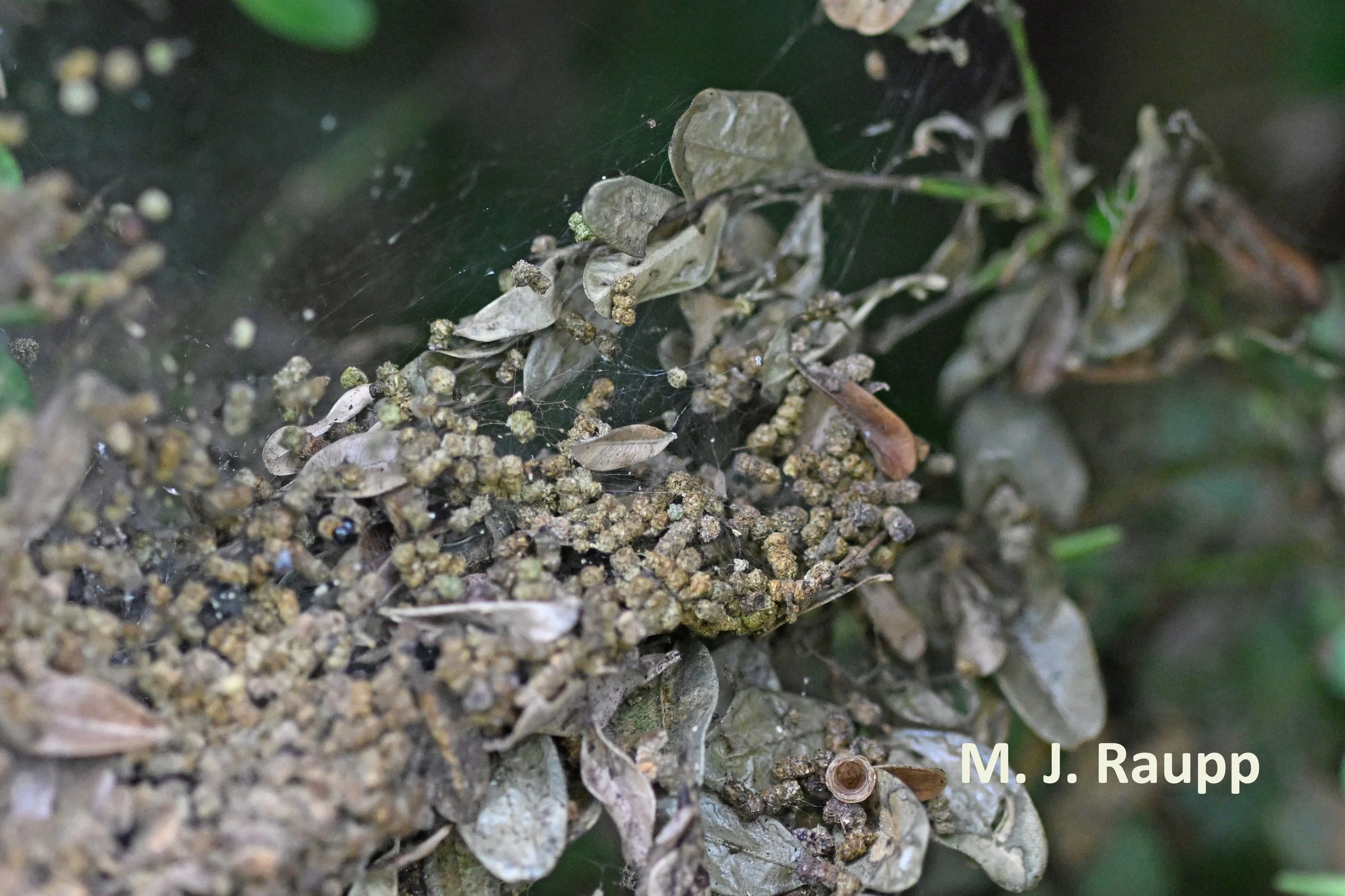
Accumulations of frass on boxwood leaves and the ground beneath the plants is a sign that your boxwood may be infested with box tree moth caterpillars.

Left unchecked, box tree moths can destroy a mature boxwood hedge in a matter of months. Image credit: Jeff Semler, UME
How is this possible? Adult boxwood tree moths lay multiple clutches of 5 to 20 eggs. Larvae that hatch from the eggs are voracious herbivores that first remove green leaf tissue as youngsters and later consume entire leaves. And if this was not bad enough, after leaves are consumed, they feed on woody tissues, thereby girdling stems and branches, and hastening boxwood death. One generation of this carnage is bad enough, but box tree moth will have many generations in the DMV. In other locations, as many as 4 or 5 generations may occur annually depending on temperature regimes.
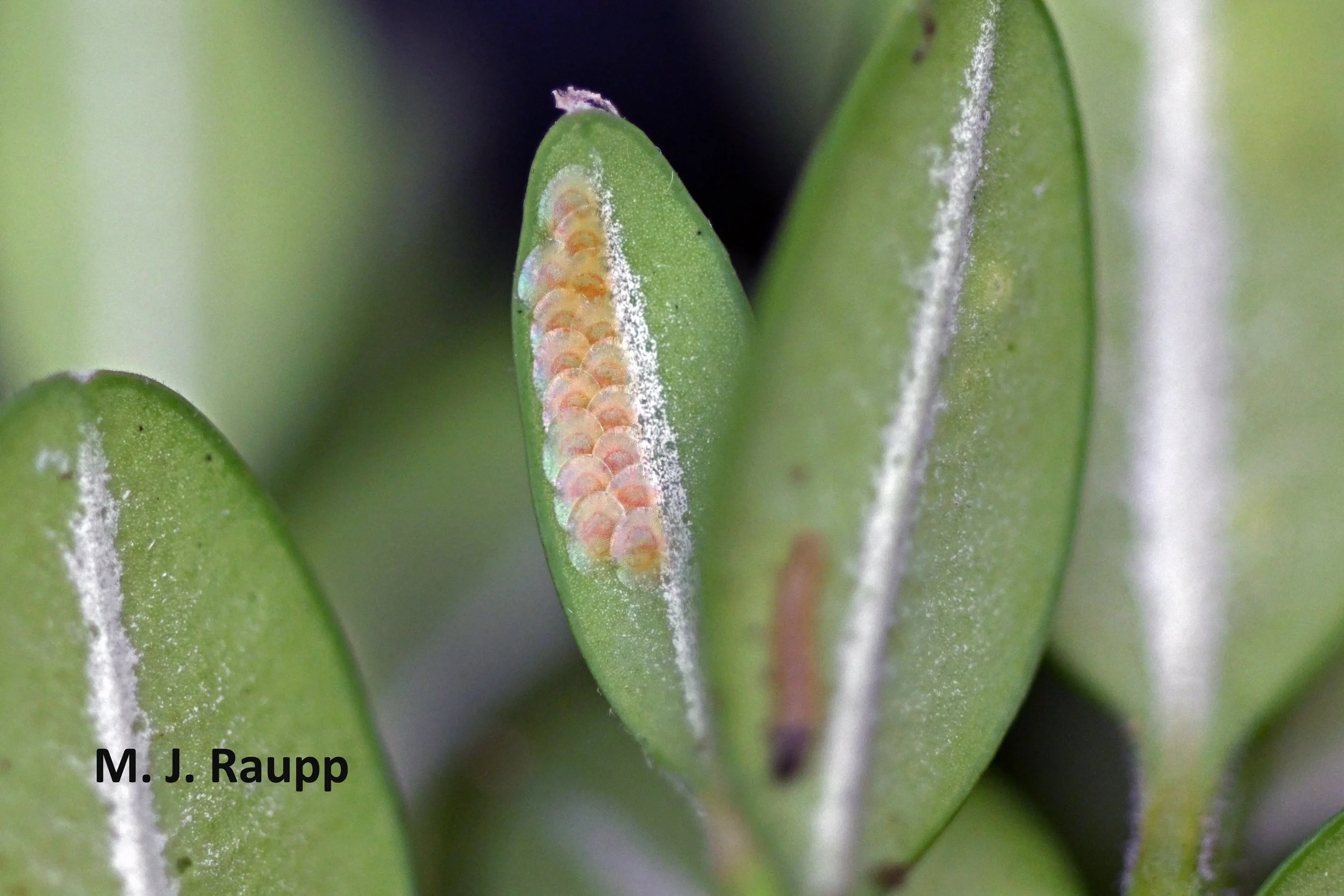
Eggs of box tree moth are pale yellow, translucent, and deposited in ranks of five to twenty on boxwood leaves.
What should you look for? Discoloration, a change in the color of leaves from vibrant green to dull brown or gray, and defoliation, the loss of parts or entire leaves, are often the first and most easily recognizable clues that your boxwoods may be infested with box tree moth. Since no native moth or butterfly has caterpillars that readily eat leaves of boxwoods, the presence of large numbers of strikingly colored black, green, and yellow striped caterpillars with black heads is a dead giveaway for the presence of box tree moths. However, several other arthropod pests and diseases can cause discoloration, defoliation, and dieback on boxwoods. Fortunately, Joe Boggs of The Ohio State University has compiled a wonderful pictorial guide to diagnosing boxwood pests and diseases including symptoms and signs of box tree moth.
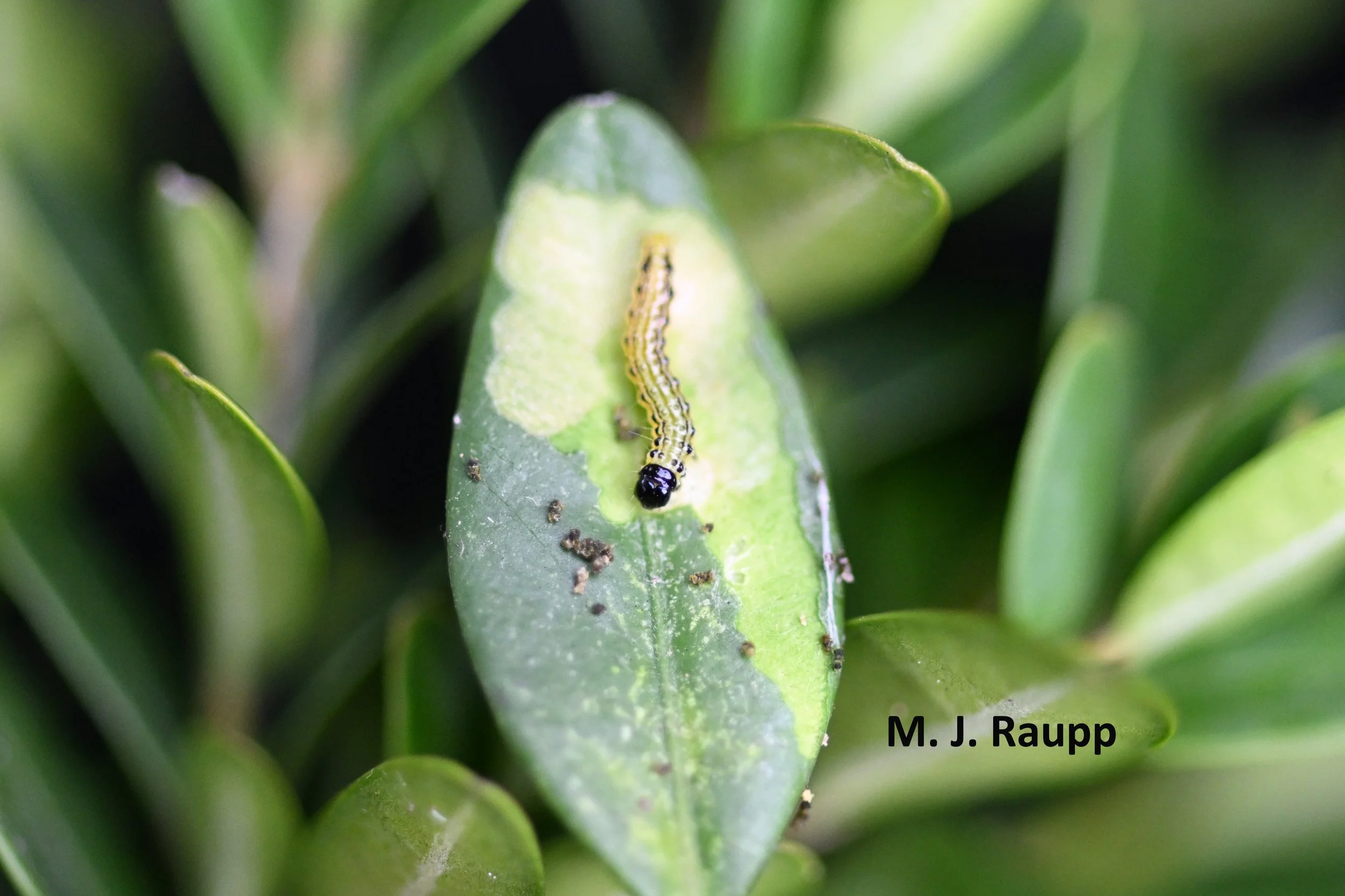
Newly hatched caterpillars of box tree moth create tiny white patches on boxwood leaves as they remove leaf tissues.
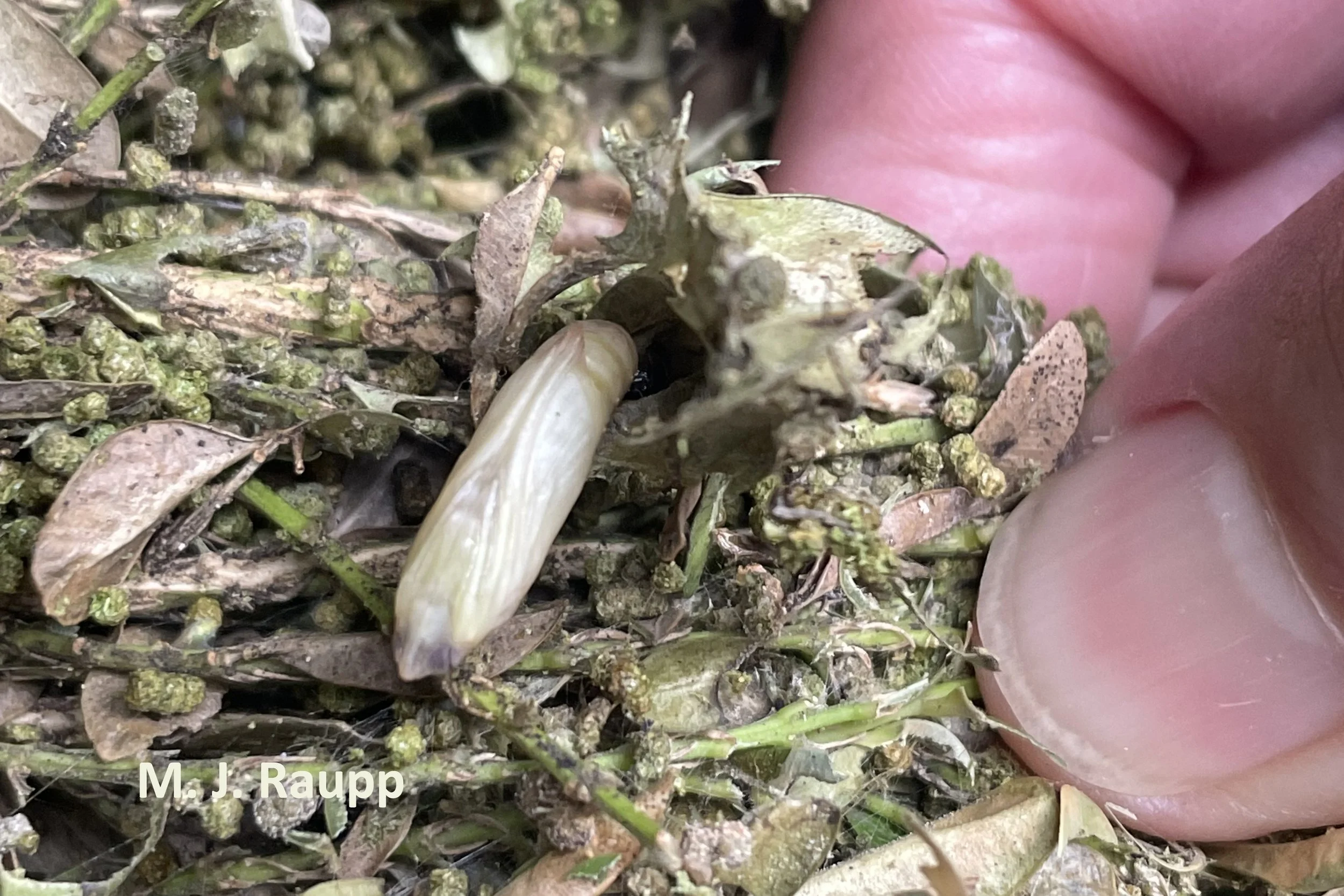
The final annual generation of adult box tree moths emerged from ethereal pupae hidden in the foliage of boxwood leaves in late summer here in the DMV.
What should you do if you find box tree moth in Maryland? The Maryland Department of Agriculture is presently engaged in a program to limit the spread of box tree moth. If you suspect you have this pest, the Department of Agriculture recommends the following:
· If you suspect your boxwoods may be infested with the box tree moth, please contact via email the Plant Protection and Weed Management program at ppwm.mda@maryland.gov. Please attach a picture in your email.
· Allow Maryland or Federal agricultural officials to inspect your boxwood plants and place detection traps.
· Any infested material should be doubled bagged in plastic bags and placed in the trash.
· Nursery owners should monitor their boxwoods and implement safeguards to limit pest risk. All licensed nurseries should report BTM detections to the Maryland Dept of Agriculture Nursery Inspection Program or reach out to their nursery inspector.
Moving forward, what might the future hold for the box tree moth and us? Unfortunately, like emerald ash borers, brown marmorated stink bugs, spotted lanternflies and many other non-native pests of our landscape plants, the box tree moth is likely here to stay. However, Mother Nature in cooperation with humans often has a solution for these invaders. Indigenous natural enemies, predators, parasitoids, and pathogens often rally and put a beat-down on these non-native pests. Clever scientists search and discover natural enemies from afar and after exhaustive evaluation release them to reduce populations of invaders here in the US. Researchers develop chemicals to detect, attract, trap, and kill non-native pests. Even today several insecticides are available to kill caterpillars. Some of these contain active ingredients like Bacillus thuringiensis, a.k.a. BT, and spinosad which are dynamite for controlling caterpillars but safe enough to be used in organic food production. If you want to learn more about insecticides that can be used to manage box tree moth caterpillars, click on this link. With diligence, ingenuity, good science, and help from Mother Nature, we will find ways to manage this new noxious invader.”
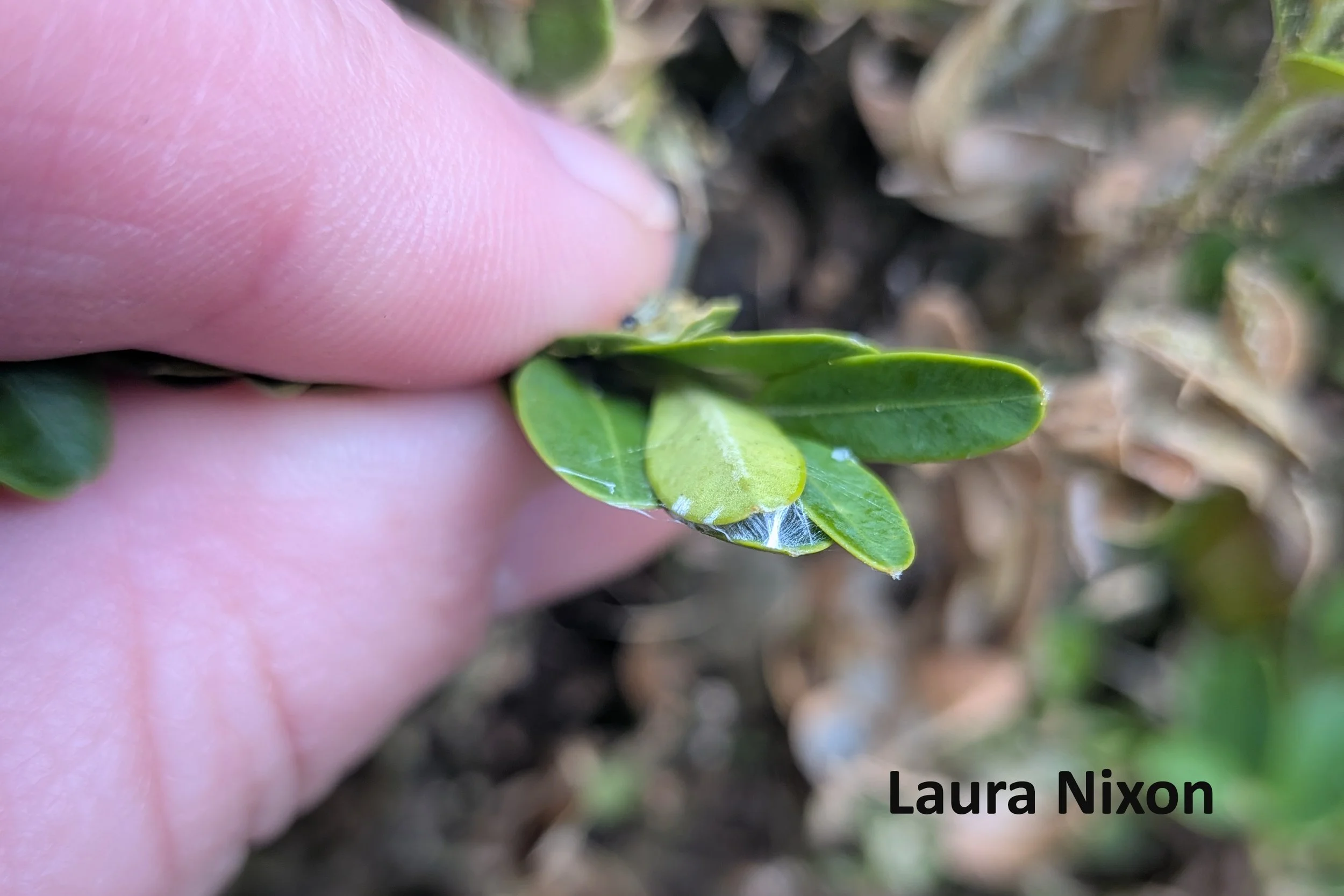
In fall, caterpillars not yet fully developed form refuges in leaves called hibernacula to survive winter’s chill. Image credit: Laura Nixon
Acknowledgements
We thank Jeff Semler and Paula Shrewsbury for providing images and Laura Nixon for deep insights into box tree moth here in the DMV. “The fast invasion of Europe by the box tree moth: an additional example coupling multiple introduction events, bridgehead effects and admixture events” by Audrey Bras, Eric Lombaert, Marc Kenis, Hongmei Li, Alexis Bernard, Jérôme Rousselet, Alain Roques, and Marie‑Anne Auger‑Rozenberg was used as a reference for this episode. The inspiration for this episode came from Phyllis and Rod, who allowed us to photograph their boxwoods and caterpillars. Please visit Box Tree Moth by Madeline Potter, UMD Extension, to learn more about this pest and to find additional sources of information.