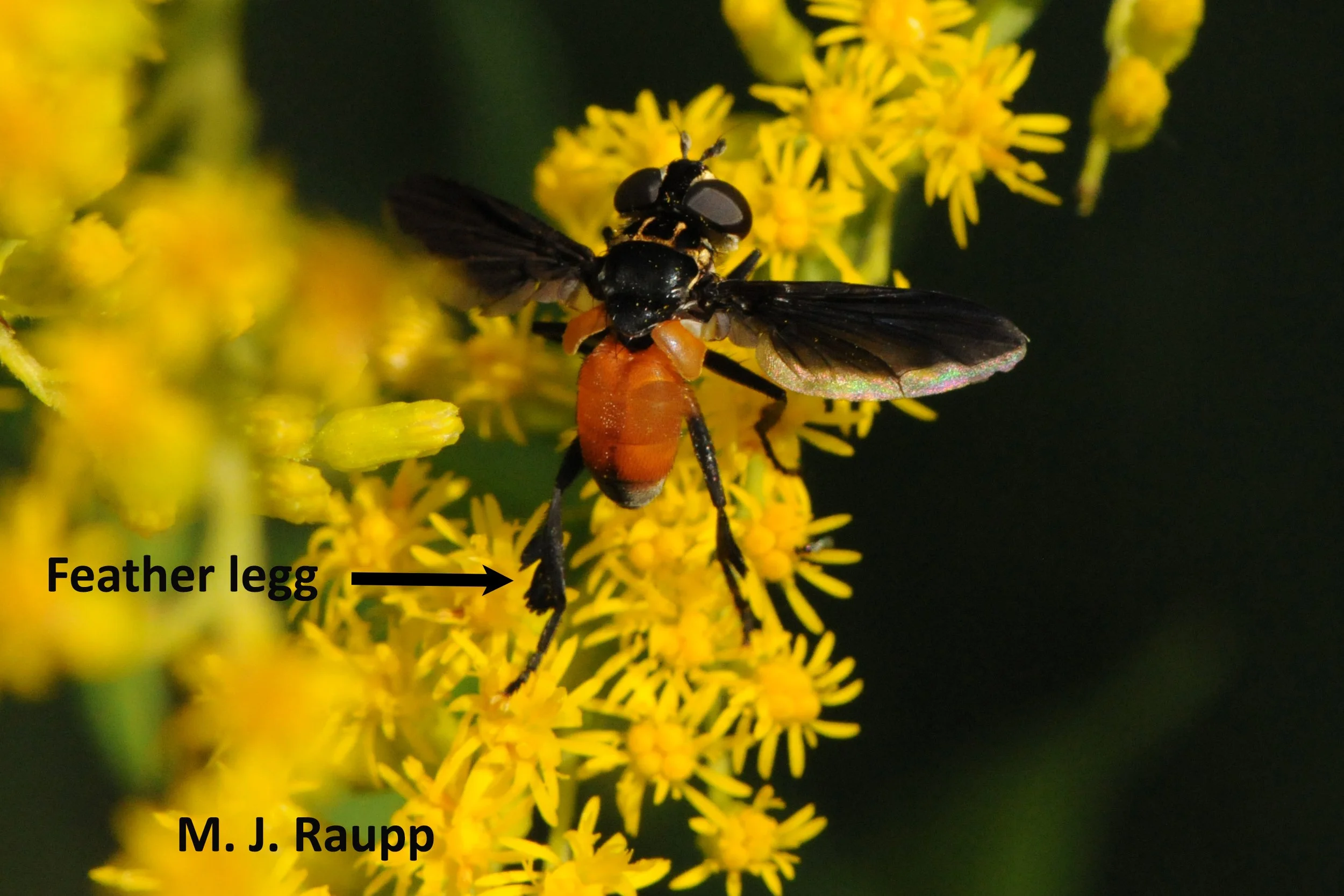
Three weeks ago, we visited leaffooted bugs that dropped a leg to save their life. At the end of the video clip, we met a five-legged survivor of an apparent attack bedecked with two small white blobs attached to its back. We promised to revisit this bug to learn the story of the strange ornaments on its back. Here’s the deal. The white blobs on the back of the leaffooted bug are eggs deposited by a pretty parasitic fly known as a feather-legged fly. Feather-legged flies belong to a clan of parasitic flies called tachinids. Some tachinids attack caterpillars, including the nefarious gypsy moth caterpillar, but feather-legged flies have a penchant for attacking members of the “true bug” clan, insects with sucking mouthparts and immature stages called nymphs. Female flies tangle with their true bug victims and attach eggs to the exoskeleton of the host often in places where it is difficult for the host to remove them. Eggs hatch and fly larvae bore into the host to develop. When their development is complete, they exit, drop to the ground and pupate in the soil. Adults emerge from the soil to feed, mate, and find new bugs to attack and parasitize.
Three weeks ago we visited a leaffooted bug that dropped a leg to save its life. At the end of the video clip, we noticed two small white blobs attached to its back. The blobs are eggs deposited by a pretty parasitic tachinid fly known as a feather-legged fly. The eggs hatch and the fly larvae bore into the host to develop as they dine on their host. When their development is complete, the larvae exit, drop to the ground and pupate in the soil. Adults emerge from the soil to feed, mate, and find new bugs to attack and parasitize. Pretty feather-legged flies are common visitors to goldenrods in late summer and autumn. In addition to attacking native insects, feather-legged flies put a beat down on invasive pests like nefarious brown marmorated stink bugs.
But how do these smallish flies find their hosts in a very big world? Insects communicate in a variety of ways using sight, sound, and volatile chemicals to find and join other members of their species. Chemicals used for communication by members of the same species are called pheromones. In a series of fascinating studies, Jeff Aldrich and his colleagues discovered how these parasitic flies locate their victims. Many species of true bugs produce pheromones that serve as assembly calls for purposes of mating and defense. Tachinids use aggregation pheromones of true bugs for their own mischievous purpose, to find hosts that will serve as food for their parasitic offspring. While this tale may seem a little dark, the good news here is that native Trichopoda flies have joined other allies, including wheel bugs, garden spiders, robber flies, mantises, and wasps to stymie the shenanigans of invasive pests including the brown marmorated stink bug.
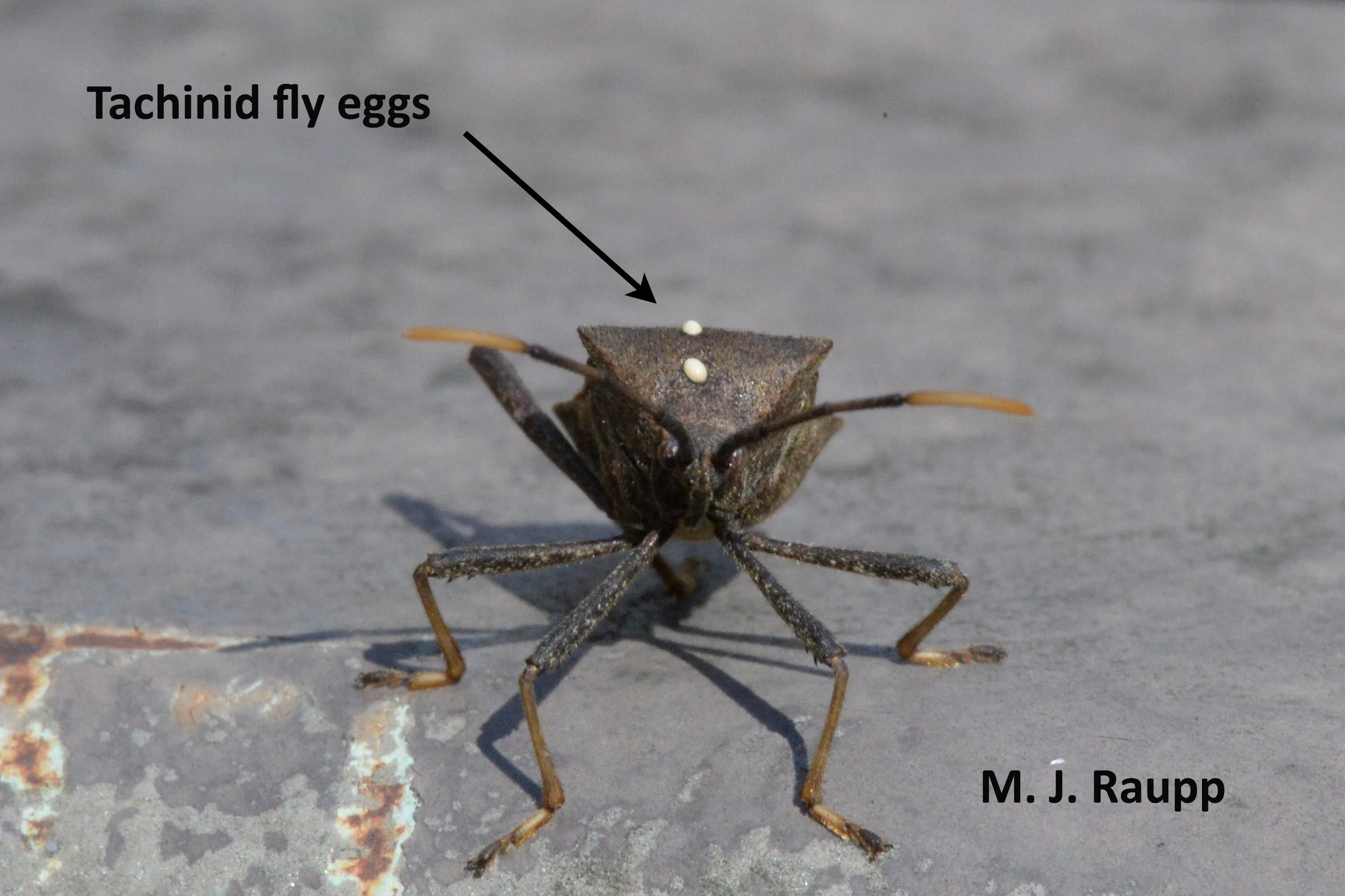
Two white eggs deposited just behind the head of this leaffooted bug are the handiwork of a tachinid fly. They spell doom for this hapless hemipteran.
Acknowledgements
The intriguing references “The biology of Trichopoda pennipes Fab. (Diptera, Tachinidae), a parasite of the common squash bug by Harlan Worthley, “Bug pheromones (Hemiptera, Heteroptera) and tachinid fly host-finding” by Jeff Aldrich, Ashot Khrimian, Aijun Zhang, and Peter Sherer, and “Parasitism of the Invasive Brown Marmorated Stink Bug, Halyomorpha halys (Hemiptera: Pentatomidae), by the Native Parasitoid, Trichopoda pennipes (Diptera: Tachinidae)” by Neelendra K. Joshi, Timothy W. Leslie, and David J. Biddinger were used to prepare this episode.