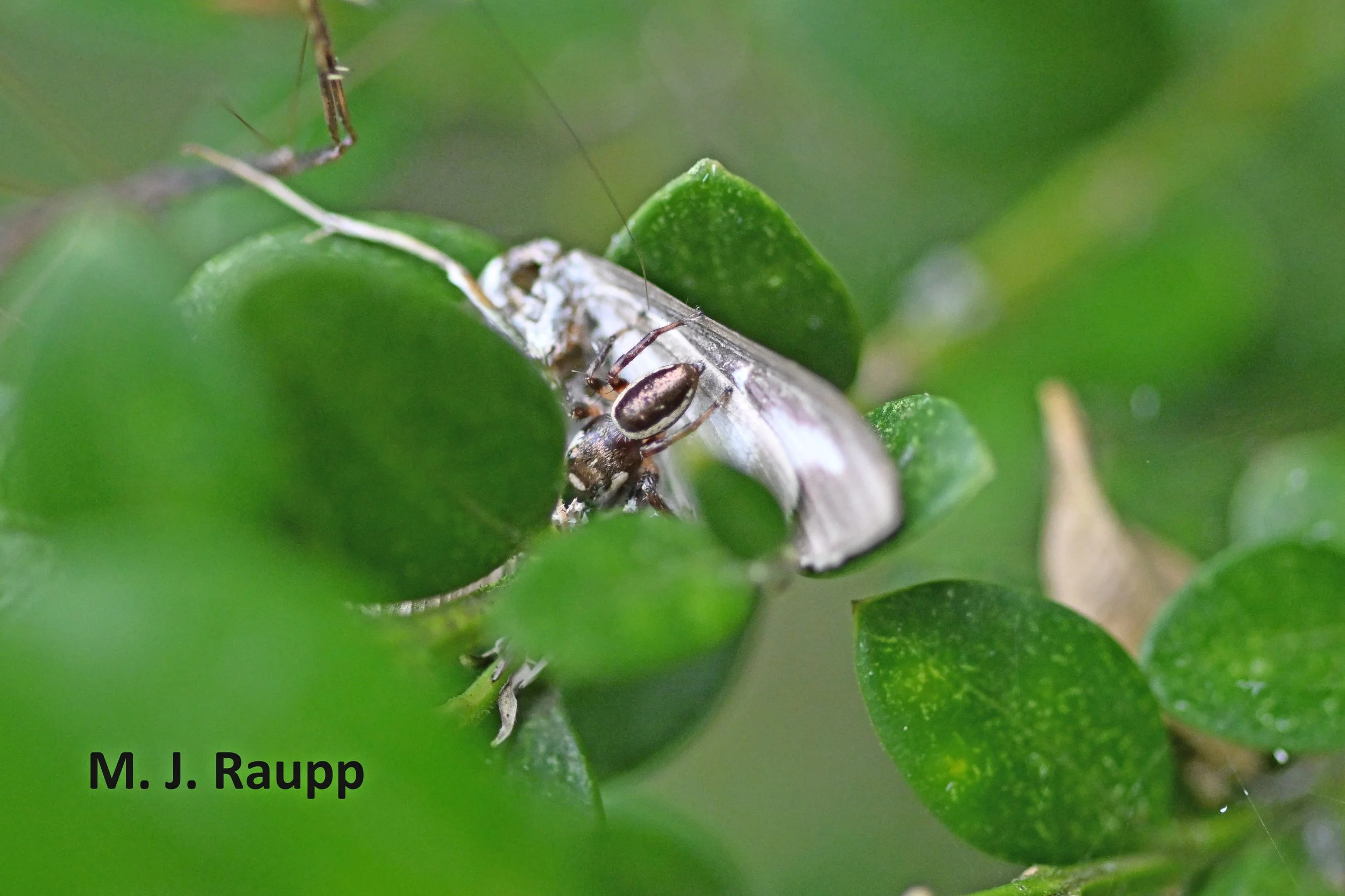
In last week’s episode, we caught up with the fast-moving box tree moth (BTM) as it spread its path of destruction to historic boxwoods in the DMV. While observing and photographing BTM at an antebellum mansion in western Maryland, I discovered an adult BTM laying motionless on a branchlet of boxwood. Upon closer inspection, I discovered a handsome bronze jumping spider nestled in the leaves consuming the soft tissues of the moribund moth. This beautiful jumping spider belongs to the family called Salticidae. The Latin root for this clever clan of spiders is saltare which means “to jump.” These hunting spiders do not build orb webs like black and yellow garden spiders and spotted orb weavers we met in previous episodes. Instead, using exceptionally large forward-facing eyes, they react strongly to visual cues, stalk their prey, and with catlike speed pounce upon their victim and immobilize it with powerful fangs. Compound eyes and fangs are often striking iridescent shades of metallic greens and blues.
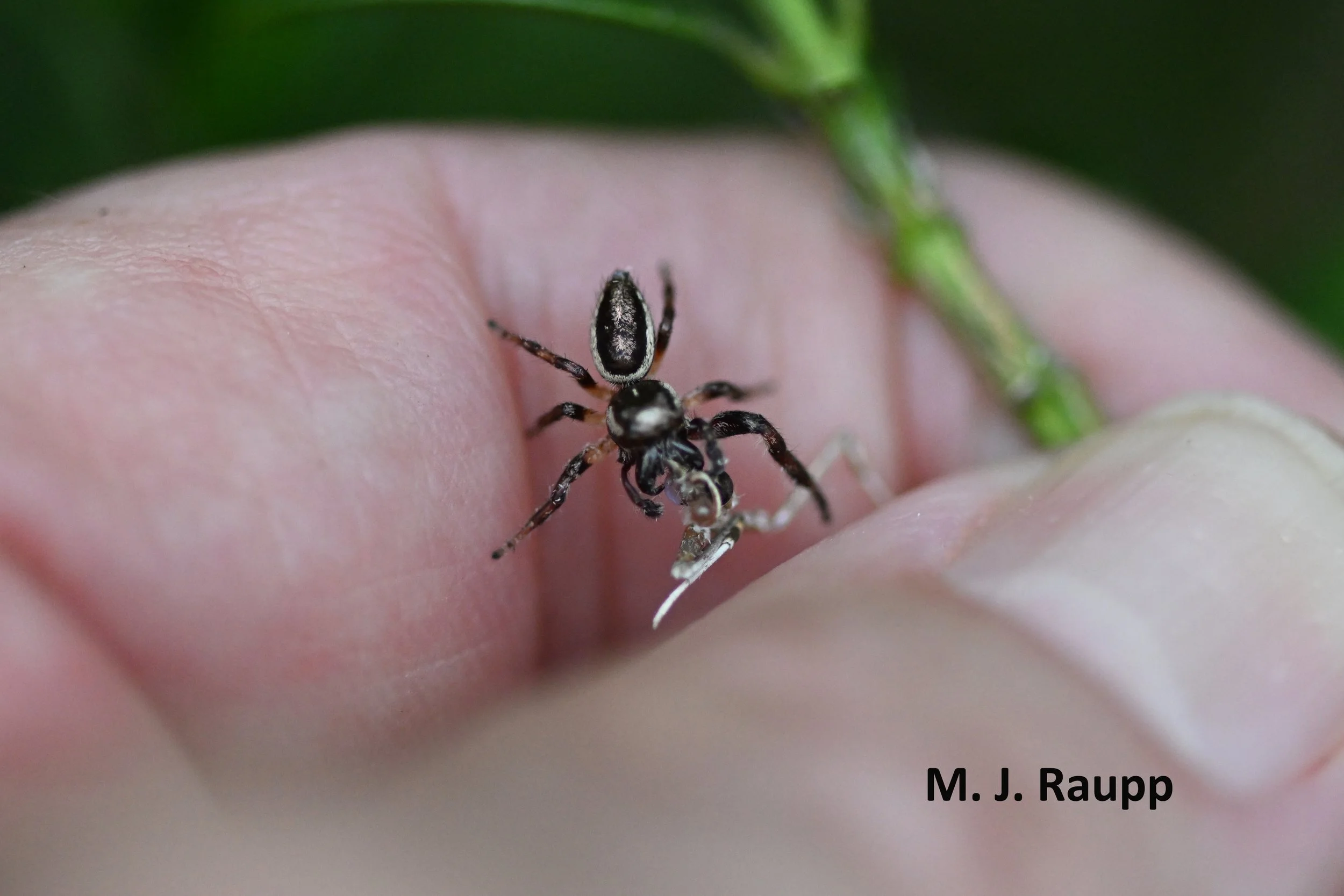
After its box tree moth snack was disturbed by a bug geek, this charming bronze jumping spider clambered onto my hand with parts of the moth still clinging to its fangs.
This act of predation against BTM was encouraging until a stealthy assassin appeared on the scene. Check out the video. Lurking near the jumping spider and its prey was a thread-legged assassin bug named Emesaya brevipennis. This rascal might pose a threat to the beneficial jumping spider. Scarce accounts of the behavior and ecology of this assassin bug suggest that Emesaya may consume the victims of spiders or attack and eat spiders. Look out jumping spider! Thread-legged assassin bugs have also been reported to eat small flies and each other.
Recently, I happened to catch a glimpse of a handsome bronze jumping spider feasting on the belly of a box tree moth. What I didn’t expect to see was a sneaky thread-legged assassin bug lurky nearby. You can see it at the left of the screen. This slender assassin bug could spell trouble for our helpful spider. Scientists have reported this assassin to rob spiders of their prey or worse yet, directly attack and kill spiders. After I shooed the assassin bug away, the jumping spider glammed for the camera showing off its amazing iridescent emerald eyes. Looks like Mother Nature’s team of beneficial predators is starting to put a beatdown on this new invader to North America.
Is this act of predation good news for the dastardly BTM? You bet, but this is not entirely surprising. As we have seen, indigenous natural enemies, predators, parasitoids, and pathogens often rise-up to help put beatdowns on invaders like brown marmorated stink bugs and spotted lanternflies when these invaders arrive in the US. In a previous episode we traced the invasive history of BTM, first of Europe and now of North America. Recent studies of the BTM in invaded European countries including France and Romania found their native predators, including spiders, beetles, true bugs (Hemiptera), and birds, waging war on BTM. Several species of parasitic flies and wasps also attack and kill BTM eggs and caterpillars. Pathogens also take their toll on BTM in Europe and Asia with many bacteria and fungi infecting and killing BTM. Let’s hope that Mother Nature quickly summons her team of beneficial predators, parasitoids, and parasites to help hold BTM at bay.
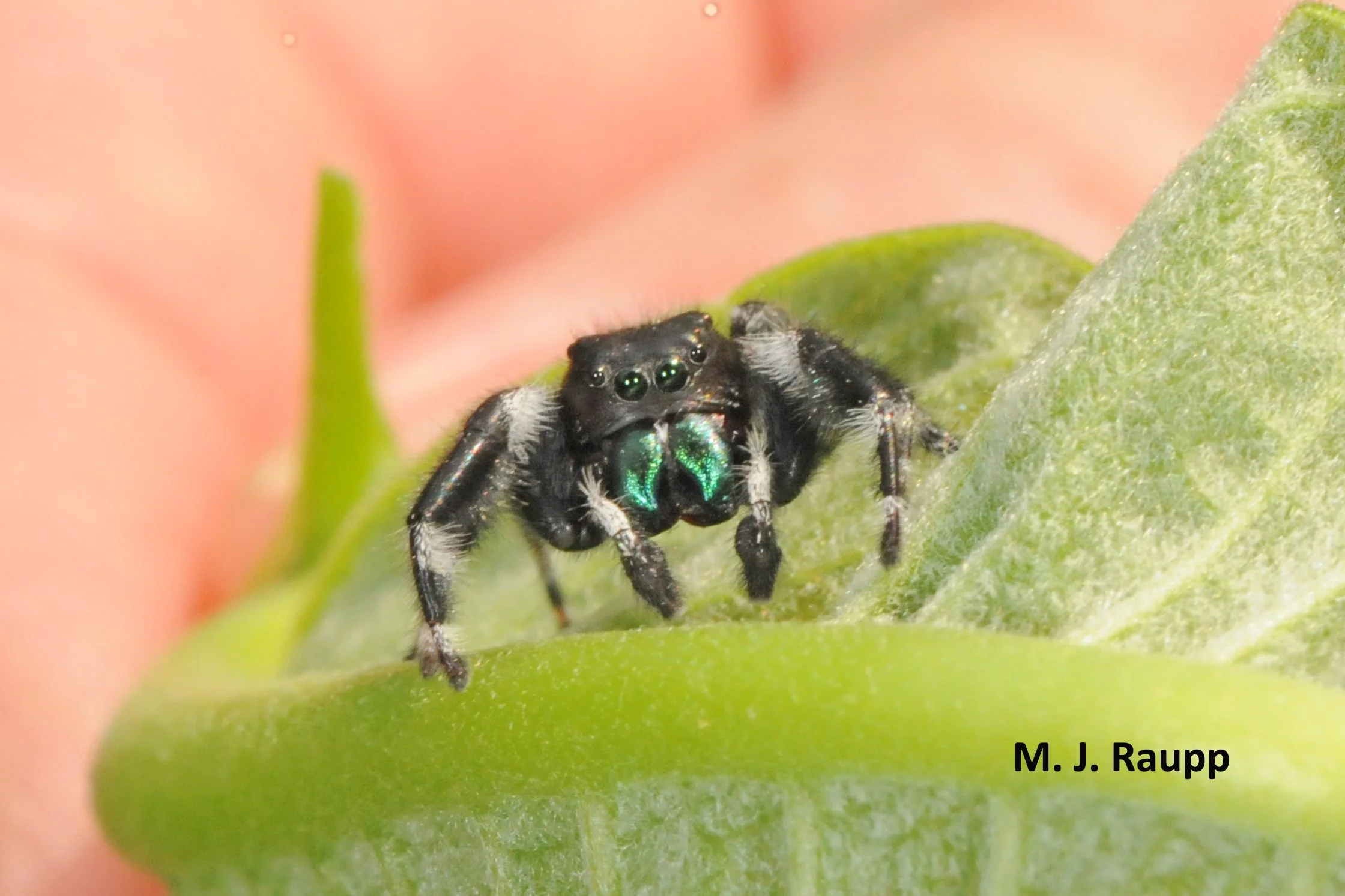
Jumping spiders have enormous eyes and fangs that are often iridescent colors of green or blue like the fangs of this handsome bold jumping spider.
Acknowledgements
These interesting articles were used to prepare this episode of Bug of the Week: “Observations on the Life History and Behavior of the Thread-Legged Bug Emesaya brevipennis (Say), (Hemiptera: Ploiariidae) L.” by Harley P. Brown and David W. Lollis, “Research for native parasites and predators of the box tree moth Cydalima perspectalis , in natural boxwood forest in France” by Emeline Morel, Mathilde Capelli, Marinede Bodard, Etty Colombel, Thomas Michel, and Elisabeth Tabone, and “Zoophagous entomofauna and entomopathogenic agents reported on Cydalima perspectalis (Walker, 1859) in north-eastern of Romania” by Ionuţ B. Hulujan, Teodora Florian, Vasile C. Florian, and Ion Oltean.